Reichsaramäisch.

I’m continuing to read Schniedewind’s A Social History of Hebrew (see this post), and I thought I’d pass along this interesting paragraph on the effect of the official adoption of Aramaic in the Near East:

Vernacularization—that is, literary communication aimed at the masses—was critical to the emergence of empire in the ancient Near East. Referring to the formation of European and Indian societies, Sheldon Pollock observes that “using a new language for communicating literarily to a community of readers and listeners can consolidate if not create that very community, as both a sociotextual and a political formation.” In the case of the ancient Near East, the simplicity of the alphabet as opposed to the cumbersome cuneiform writing system likely informed this choice. More than this, as a result of the spread of Aramaic, cuneiform itself became a restricted and esoteric writing system in the Persian and Hellenistic periods, being supplanted by Aramaic in the administration of far-reaching parts of the empire. To perform its new functions, a literary standard was created, which scholars have called Official Aramaic (or Imperial Aramaic, or Reichsaramäisch). Hitherto, Aramaic had been a cacophony of different dialects. The standardization and concomitant simplification of Aramaic was a natural consequence of its wide diffusion under imperial authority. Such tendencies are also evident in the wake of Alexander’s conquest and in Arabic in the aftermath of the advent of Islam. For this reason sociolinguists point to Aramaic as “a classic case of imperialism utilizing a foreign language instead of trying to impose its own.”

Schniedewind goes on to talk about the promulgation of Aramaic under the Persian Empire as a literary standard, as a result of which the books of Ezra and Daniel are written in Official Aramaic; “when the torah … was read aloud in Jerusalem during the Persian period, it apparently needed to be translated into Aramaic to be understood…. Clearly, Hebrew was no longer understood by the majority of people, and this is also reflected in the epigraphic record.”

Shiloh, Silom.

This is one of those selfish posts of no general interest; I’m just hoping someone out there can satisfy my curiosity about a trivial etymological point. The Russian equivalent of Shiloh (the ancient city, Hebrew שִׁילֹה‎) is Силом [Silom]. The first part of the word is entirely understandable, because the Greek version is Σηλώ, which has been pronounced /silo/ since the Byzantine period, when the Russians would have borrowed it. (I say “Russians” because even Ukrainian has Шіло [Shilo], without the -m.) I asked Sashura what he thought, and he suggested it was contamination from Силоамская купель, the Pool of Siloam in Jerusalem. That’s a perfectly reasonable suggestion, and I’m provisionally adopting it to ease my mind, but if anybody knows anything more definite, I’m all ears. (Curiously, the -m of Siloam is not original, since the Hebrew is שִּׁילוֹחַ [Shiloakh]; it’s from Greek Σιλωάμ, and I guess I’m curious about why the Greeks stuck an -m on there as well.)

Loan Words.

I’m so used to news media having uninformed pieces on language that it’s a pleasure to find exceptions; BBC News had a magazine story on loan words by Philip Durkin, who — being deputy chief editor of the OED — is definitely up to the task, with interesting tidbits like this:

Today English borrows words from other languages with a truly global reach. Some examples that the Oxford English Dictionary suggests entered English during the past 30 years include tarka dal, a creamy Indian lentil dish (1984, from Hindi), quinzhee, a type of snow shelter (1984, from Slave or another language of the Pacific Coast of North America), popiah, a type of Singaporean or Malaysian spring roll (1986, from Malay), izakaya, a type of Japanese bar serving food (1987), affogato, an Italian dessert made of ice cream and coffee (1992).

I found the odd-looking quinzhee in the OED and discovered it’s pronounced /ˈkwɪnzi/ (QUIN-zee, just like the traditional pronunciation of Quincy) and is from “Slave kǫ́ézhii, lit. ‘in the shelter’, or < a similar form in another Athabaskan language." And they ran a followup piece in which Durkin “looks at readers’ own favourite examples”; there are lots more goodies there. A sample paragraph:

It is often useful to distinguish between immediate and remoter origins of words. For instance, among the French borrowings into English in the original article, peace comes from an earlier form of French paix which goes right back to the Latin origins of the French language (the Romans spoke about pax), but war comes from a northern variant of French guerre, a word which French originally borrowed from a Germanic relative of German and Dutch. A similar example noted by a reader is boulevard, a word that English borrowed from French in the 1760s, but that French itself borrowed in the Middle Ages from Dutch bollwerk or a related word, making the word seem more familiar by substituting the ending -ard of words like placard. In some cases English acts as the middle-man — cake probably came into English from early Scandinavian in the 1200s, but has since been borrowed from English into numerous languages in Europe and beyond.

Unfortunately, the last paragraph goes a bit astray, beginning:

Just sometimes, though, many languages across the world will have similar words in the same meaning for reasons other than borrowing. The clearest example is probably from words for “mother” and “father” around the world that are superficially similar to mama, dada, or papa. Such words all ultimately go back to the sounds that babies throughout the world produce when they first start to master the art of producing distinct speech sounds, the familiar “mamamamama” or “dadadadadada” that few parents can help interpreting as their own special greeting, and that have given rise to many and various words for mother and father all around the world.

Obviously, a far more common reason for languages having “similar words in the same meaning for reasons other than borrowing” is that they are cognate, like French cinq and Spanish cinco. I presume the problem lies in the editing process; it’s just a miracle there aren’t more blunders on that account. At any rate, I encourage BBC News and everyone else to let professionals write their language pieces instead of inserting ignorant reporters into the mix. (Thanks, Paul!)

Update (August 2015): I should have added this infochart with accompanying essay by Durkin back in 2014, but better late than never.

Gogol’s Gamblers.

One of the best things about my omnivorous approach to nineteenth-century Russian literature is that I stumble on good things I would never have read otherwise. I almost passed up Gogol’s play «Игроки» [The Gamblers]; much as I love Gogol, I was put off by Mirsky’s description (“It is an unpleasant play, inhabited by scoundrels that are not funny, and, though the construction is neat, it is dry and lacks the richness of the true Gogol”) and by the fact that Nabokov says not a single word about it in his book on Gogol, not even bothering to call it “a rather slipshod comedy” as he does «Женитьба» [Marriage, or as Nabokov calls it, Getting Married]. But I sighed, thought “If I don’t read it now, I never will, and after all, it’s Gogol,” and gave it a try. It turns out it’s a wonderful play that simply fell through the cracks of Mirsky’s and Nabokov’s artistic sensibilities. It should, however, fit perfectly with the sensibilities of an age that appreciates, say, David Mamet. These days we don’t need uplifting or well-rounded characters in our drama — a well-turned, clever plot and punchy dialogue makes us happy. (And come on, there’s a deck of cards named Adelaida Ivanovna!) If you liked The Sting or The Usual Suspects, I bet you’ll like this play. (I know there are translations into English, but I don’t know if any of them are any good; there’s a 1927 one by Isaac Don Levine online, but a quick glance suggests it’s pretty creaky, though Levine does call the play “a masterpiece of dramatic suspense” at the end of his brief introduction.)

Addendum. Here is a filmed version of the play (in Russian); the actors are perfect for their parts.

Nobody Said That Then!

That’s the title of a New Yorker blog post [archived] by Hendrik Hertzberg, a senior editor and staff writer, who is upset that “the makers of movies and television shows set in the historical past” take pains with everything except the language, listing examples from the show Masters of Sex, set in St. Louis in the early nineteen-fifties, e.g. “I’m going to pass on the bacon”: “People played a lot of bridge back then, but ‘pass on,’ as a metaphor for skipping or refusing something, was not yet in use.” This of course warms my heart, but I was also surprised and irritated that he didn’t mention Benjamin Schmidt’s Prochronisms site (see this LH post from last year), which has been working that territory for some time now and deserved a shout-out. Schmidt responds with this post, in which he quotes Hertzberg’s “Are there no production designers for language? There ought to be” and responds “Be reassured, Hendrik: we exist!” (I was impressed by his limiting himself to such a mild complaint at being ignored); he goes on to point out that “Hertzberg’s not right about all of his claims” and provide some nifty graphs. Anyway, if you like this sort of thing, read both posts, which are short and meaty.

Addendum. A good response to Hertzberg by Ammon Shea, pointing out that “words have a nasty habit of first appearing much earlier or later than memory or intuition would attest” (though also stipulating that “he is largely correct: some of the words he calls into question were not actually used at that time, and some of the others were not in widespread use”).

Balzac’s Goriot.

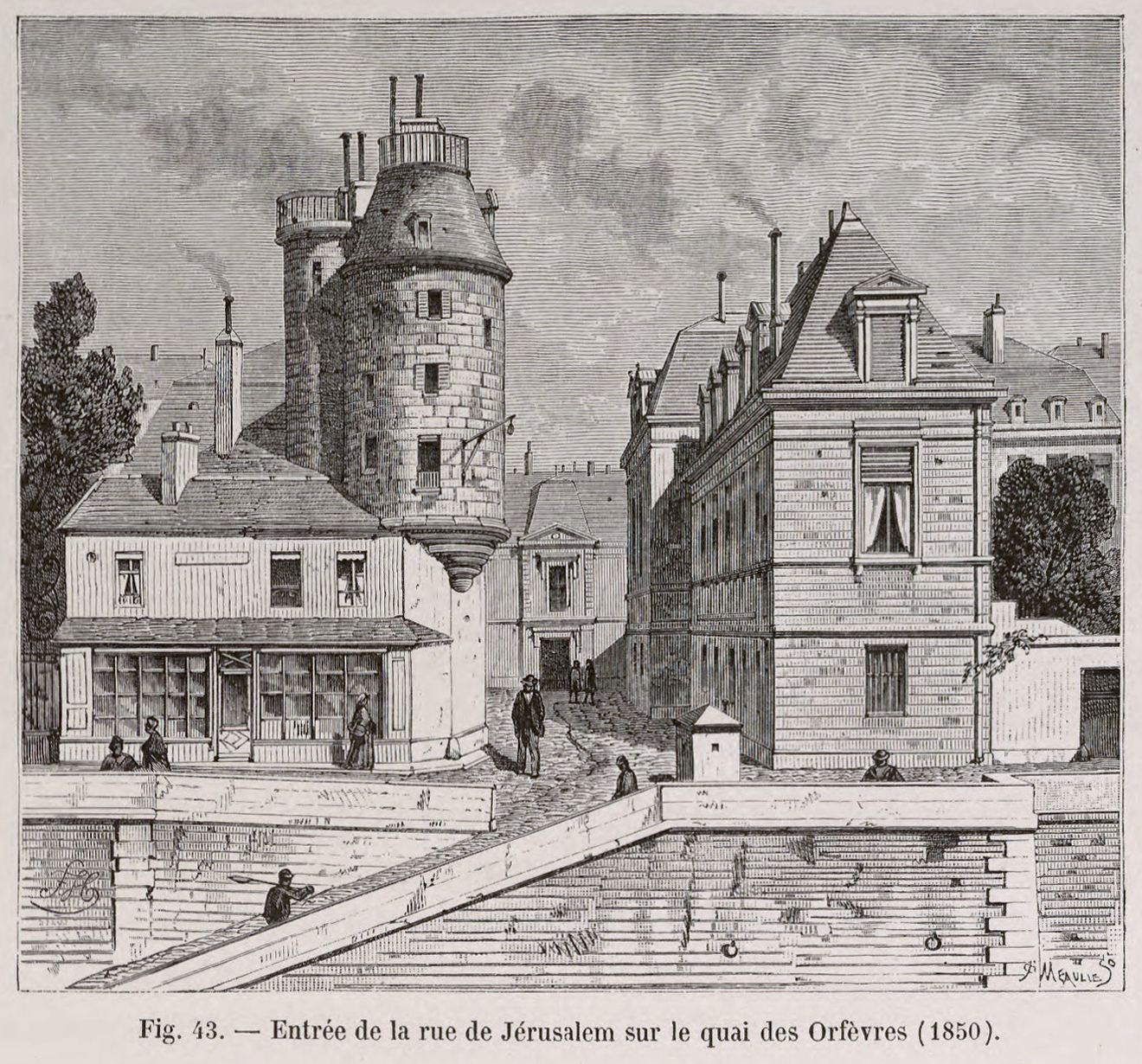
I was hard on Balzac after I read La Peau de chagrin (see this post), but marie-lucie and others insisted I give him another chance, and they were right. Since then I’ve read Eugénie Grandet and Le père Goriot (which I just finished), and my opinion of him is much higher. I agree with Amateur Reader (Tom) that Eugénie Grandet is an extraordinarily artful novel, and I suspect I’d agree with him that it’s Balzac’s best even if I’d read a great deal more Balzac than I have, but I didn’t find any reason to post about it here. I don’t think Le père Goriot is up to that level — it gets too wildly melodramatic for my taste — but it’s a great read, and very satisfying to my intense desire to know the minutiae of pre-Haussmann Paris (I spent quite a bit of time happily investigating the long-gone rue de Jérusalem on the Île de la Cité, which was once the metonym for the Paris police the way quai des Orfèvres is today; here‘s a nice view of it from the quai, and here‘s an actual photograph: you can practically smell the effluvia). One LH-worthy feature of the book is Balzac’s attention to the linguistic usages of various subgroups, notably the criminal classes. At one point he has a cop use a couple of (helpfully italicized) words he’s picked up from the lowlifes he deals with:

— Vous vous trompez, répondit il, Collin est la sorbonne la plus dangereuse qui jamais se soit trouvée du côté des voleurs. Voilà tout. Les coquins le savent bien, il est leur drapeau, leur soutien, leur Bonaparte enfin, et ils l’aiment tous. Ce drôle ne nous laissera jamais sa tronche en place de Grève(1). Il nous joue.

And he provides this footnote explaining the terms (a sorbonne is a living head, a tronche a dead one):

Sorbonne et Tronche sont deux énergiques expressions du langage des voleurs, qui les premiers ont senti la nécessité de considérer la tête humaine sous deux aspects. La Sorbonne est la tête de l’homme vivant, son conseil, sa pensée. La Tronche est un mot de mépris destiné à exprimer combien la tête devient peu de chose quand elle est coupée.

And later on he has the fearsome Collin say “Ne soyez pas embarrassé, je sais faire mes recouvremens. L’on me craint trop pour me flouer, moi!” and promptly explains that this jargon is the result of the conditions of hard labor (le bagne):

Le bagne avec ses mœurs et son langage, avec ses brusques transitions du plaisant à l’horrible, son épouvantable grandeur, sa familiarité, sa bassesse, fut tout à coup représenté dans cette interpellation et par cet homme, qui ne fut plus un homme mais le type de toute une nation dégénérée, d’un peuple sauvage et logique, brutal et souple. En un moment Collin devint un poème infernal […]

The last (truncated) sentence about how the criminal became an infernal poem is the kind of thing that made me roll my eyes. One huge difference between Balzac and later realist writers is that Balzac can’t resist buttonholing the reader and making speeches about what it all means; Proust says more about the dehumanizing effects of wealth in one short scene than Balzac does in pages and pages devoted to the subject here. But I gobbled it all up, and I can see why he (like Dickens) is a great novelist, for all the things that put me off.

The Thirty-Three-Year Lexicon.

An enjoyable OUPblog post by Elizabeth Knowles, a historical lexicographer and editor of the Oxford Dictionary of Quotations, on how “dictionary projects can famously, and sometimes fatally, overrun”:

In the nineteenth century especially, dictionaries for the more recondite foreign languages of past and present (from Coptic to Sanskrit) were compiled by independent scholars, enthusiasts who were ready to dedicate their lives to a particular project. This may make for an exhaustively comprehensive text; it doesn’t make life easy for a publisher who needs to know when the book is going to be finished. And from the compiler’s point of view, it’s equally difficult. The passion needed to keep you going alone in the study with your pages of manuscript, is also what makes hard to recognize when it’s time to move on to the next entry. (The etymologist W. W. Skeat, who made it a personal rule not to spend more than three hours on one word, is a shining exception.)

The clergyman and scholar Robert Payne Smith’s Syriac Lexicon was signed up in 1859. Peter Sutcliffe in his “Informal History” of Oxford University Press says that it was “thirty-three years in the press and the death of thirty-one compositors,” although it’s not clear quite how the second part of this calculation was made. The files show a number of attempts by the publishers either to rein the dictionary in, or speed up the editor. In 1871, the Delegates came up with a version of performance-related pay, with £50 to be paid on the annual publication of each fascicle. The original files show that “if possible” had been entered and then crossed out—presumably someone had a well-founded scepticism as to any positive effect.

Visit the link for a dramatic photo labeled “large press camera, late nineteenth century” and the story of Lieutenant A. Mears and his 1896 proposal for “A Russian-English and English-Russian Military Vocabulary” (not accepted); in other Syriac news, Turkmen, Syriac and Asuri have been added to the official languages of Iraq. (Thanks for the links, Paul!)

Cantonese Poetry Recitation.

A recent Log post by Victor Mair presenting an “amazing video of a Hong Kong high school student reciting a couple of Classical Chinese poems” is great not only for the clip, which is lots of fun — that kid is really into the poetry! — but for the discussion, which has a striking variety of interpretations of what’s going on and why the video has gone viral in China. The South China Morning Post says “While some said they found Leung’s emotionally charged performance entertaining and creative, others said it was an overkill”; Mair asked (at least) seventeen “friends, colleagues, and students” and got seventeen different answers, and the commenters weigh in with plenty more. I myself tend to accept the idea that it’s actually (based on) a traditional, highly dramatic (to modern ears) way of reciting poetry, since I’m familiar with that kind of thing from old recordings of English and Russian poets reciting — a graduate student from Hong Kong writes Mair “I actually heard several Chinese (highly educated) say that 梁同学’s way is probably how the Tang poets recited back then! Unfortunately, people probably have to be really highly-educated to realize that…” — but it’s fascinating to see how differently people approach it. See for yourself (and enjoy the video).

(And if you’re interested in Cantonese, by all means see Mair’s latest post, Is Cantonese a language, or a personification of the devil?)

Russian in Kakania.

I just finished a long article by Gasan Guseinov, “Русский язык в современном мире” [The Russian language in today’s world] (Druzhba narodov 2, 2014), and towards the end he talks about someone I’d never heard of with a delightfully implausible idea for reforming the Austro-Hungarian Empire, so I thought I’d translate that section here (original Russian below):

Not long before the First World War and the beginning of the final stage of the dissolution of the multinational empires — Ottoman, Austro-Hungarian, British, and Russian — in 1900, in Vienna, there appeared a book by the Austrian diplomat Count Heinrich Coudenhove called Politische Studie ueber Oesterreich-Ungarn. Discussing the main source of unrest at the time in his country, Coudenhove, whose son would be, a quarter of a century later, an ideologue of the pan-European movement, suggested that Russian be made one of the state languages of the Austro-Hungarian Empire. In that way Vienna, according to the thought of this extravagant polyglot, would kill two birds with one stone: it would undermine the influence of Russia and destroy at its root the pan-Slavic movement that was rocking the boat of Kakania, as the critical intelligentsia of the day mockingly called their empire. The boat he intended to save, however, collapsed in 1918.

[…] According to the statistics of 1900, English was the global language of the gigantic British Empire, spoken natively by 100 million and fluently by 300 million worldwide. In Europe, German was in second place, spoken by 80 million — only 20 million fewer than now, sixty years after the Second World War! Proposing that the Austrians compete with the British, Coudenhove compared Russian with Urdu, spoken in Britain’s overseas possessions. Russian — a language spoken by 120 million people between the Carpathians and the Pacific Ocean, between the Arctic Ocean and Afghanistan — should be implanted, he thought, also because having it as a second language was completely “harmless” for Germans, and it would make the other Slavs renounce both the idea of pan-Slavic cultural independence and the dream of political sovereignty for “ridiculous dwarf nations.”

As always, I’m fascinated by crackpot theories, as long as they aren’t currently popular enough to annoy me!

The original Russian:

Незадолго до Первой мировой войны и начала финальной стадии распада многонациональных империй — Оттоманской, Австро-Венгерской, Британской и Российской — в 1900 году в Вене вышла книга австрийского дипломата графа Генриха Куденхове под названием «Изучая политику Австро-Венгрии». Рассуждая о главном тогдашнем источнике беспокойства для своей страны, Куденхове, сын которого станет через четверть века идеологом паневропейского движения, высказал предложение сделать русский язык… одним из государственных языков Австро-Венгерской империи. Так Вена, по мысли экстравагантного полиглота, одним ударом убила бы двух зайцев — подорвала бы влияние России и уничтожила на корню панславянское движение, раскачивавшее лодку Какании — так издевательски называла свою империю тогдашняя критически настроенная австро-венгерская интеллигенция. Спасаемая лодка развалилась, однако же, в 1918 году.

[…] По статистике 1900 года, английский язык был глобальным языком гигантской Британской империи. 100 миллионов говорили на нем как на родном, 300 миллионов владели им в мире свободно. В Европе немецкий язык был на втором месте: на нем говорили 80 миллионов — всего на 20 миллионов меньше, чем сейчас, через 60 лет после Второй мировой войны! Предлагая австрийцам равняться на британцев, Куденхове сравнивал тогда русский язык с урду в британских заморских владениях. Русский — язык, на котором говорят 120 миллионов человек между Карпатами и Тихим океаном, между Ледовитым океаном и Афганистаном, — нужно было насаждать, считал он, еще и потому, что владение им как вторым родным совершенно «безопасно» для немцев, а вот остальных славян он заставил бы отказаться и от идеи общеславянской культурной самобытности, и от мечты о политическом суверенитете «смехотворных карликовых наций».

Variety in Language.

This passage from Kugel’s How to Read the Bible (see this post) combines Biblical study with linguistics, winningly starting off with a personal anecdote:

Every language changes over time—in fact, in a remarkably short time. This lesson was brought home to me once when I was reading The Wonderful Wizard of Oz to one of my children. It starts off with Dorothy’s house being swept up by a cyclone and carried off to parts unknown. “What’s a cyclone?” my son asked, and I answered immediately, “a tornado.” That word he knew. The book had been written only seventy-five years earlier, but in that time the previously disdained “tornado” had come back to replace “cyclone” in normal American usage. Words also vary from place to place. Depending on where you were born in America, you refer to what I call “pancakes” as “griddle cakes,” “hotcakes,” “flapjacks,” or yet something else. Traveling around the country, I have noticed that local TV reporters in some regions refer to what New Englanders call an “accident” on Route 91 as a “crash.” Of course, both words exist for all speakers; it is just a matter of local preferences.

The same thing happened with biblical Hebrew—it varied from place to place and also changed over time. When scholars looked closely at the Psalter, they began to realize that its language was not all of one piece. Some psalms, like Psalm 1 or 119 or 145, used terms or expressions that were simply not found in the earlier parts of the Bible but that existed in abundance in its latest datable books. It seemed unlikely that David, even if he were a prophet, would have used a word that his own contemporaries had never heard of. Other words actually changed their meanings. To David, the word shalal meant “spoils of war, booty” (2 Sam. 3:22); this meaning persisted into later times, but then a new meaning developed, “wealth” or “treasure” (as in, for example, Prov. 31:11, “Her husband’s heart relies on her, and wealth will not be lacking [in the household]”). Why would David have used the word in the latter sense (“I rejoice in Your words as someone who has found great shalal,” Ps. 119:162) when his contemporaries would have misunderstood him to be comparing God’s words not to precious treasure but to plundered goods?

What’s more, David was a southerner, born and bred in Judah. But a number of psalms are written in a distinctly northern Hebrew—for example, they say mah to mean “don’t,” an altogether northern way of speaking (Song 5:8; 7:1; 8:4 [cf. 2:7]). When scholars find this mah, along with other northernisms and even evocations of northern geographic sites, clustered together in Psalm 42, it seems to them that the author of this psalm must have come not from Judah but some northern location. In short, the great chronological and geographical span indicated by the Psalms’ language ruled out a single author or even a single period: the Psalms were written in different places and over a long span of time.