Cutthroat Compounds.

I just got around to Stan Carey’s post from last month on a fascinating corner of English morphology:

Editor and historical linguist Brianne Hughes studies a remarkable subset of exocentric compounds called agentive and instrumental exocentric verb-noun (V-N) compounds. Mercifully, and memorably, she calls them cutthroat compounds, or cutthroats for short. These are rare in English word-formation but have a long, colourful history and constitute a very interesting category.

Cutthroat compounds name things or people by describing what they do. A cutthroat cuts throats, a telltale tells tales, a wagtail wags its tail, a killjoy kills joy, a scarecrow scares crows, a turncoat turns their coat, rotgut rots the gut, a pickpocket picks pockets, a sawbones saws bones (one of the few plural by default), and breakfast – lest you miss its etymology, hidden in plain sight – breaks a fast. The verb is always transitive, the noun its direct object.

Despite the familiarity of these examples, only a few dozen are current in modern English. It’s because they conflict with the right-headedness of English, Brianne writes in her master’s thesis (‘From Turncoats To Backstabbers: How Headedness and Word Order Determine the Productivity of Agentive and Instrumental Compounding in English’), that cutthroats’ productivity will never surpass that of ‘backstabber’ compounds, which use the far more usual N-V-er pattern. We’re ‘book readers’, not ‘readbooks’; ‘word lovers’, not ‘lovewords’.

Cutthroats largely constitute ‘a treasury of nonce words’, having peaked centuries ago. Survivors tend to be peripheral, found in slang, regional dialects, and children’s short-lived innovations. But Brianne is on a mission to catalogue them and has recorded several hundred, including such malicious archaic marvels as want-wit (stupid person), spoil-paper (bad writer), whiparse (abusive teacher), eat-bee (bird), lacklooks (unattractive person), stretchgut (glutton), clutchfist (miser), and catch-fart (servant who walks behind their master).

There’s wonderful stuff there (whiparse! catch-fart!) and much more at the link, including the cutthroats spontaneously invented by kids before they grow out of it.

Hebrew Slang.

Fred Skolnik (editor in chief of the Encyclopaedia Judaica) has a great piece in the Ilanot Review about Hebrew slang. There are also some absurd generalizations sprinkled here and there (British English is “calcified and effete,” journalists “speak and write in platitudes”), but ignore them and enjoy the lively descriptions of Hebrew and its slang. A couple of excerpts:

Also “fuck,” which becomes fack (rhymes with sock), is regularly exclaimed without any real sense of what is being said, though focking is perceived as somewhat strong even if one does not grasp the full force or resonance of the word. At the same time, a word like manyak with its independent Arabic (cocksucker) and English (maniac) origins became totally confused in Hebrew speech and has been used in both senses, sometimes with the (inexplicable) force that the British “bloody” had fifty years ago and therefore not heard in polite society, and sometimes with far less sting for someone acting in a crazy or outrageous way. I would guess that the word was first used in the Arabic sense by Oriental Jews and then picked up by Ashkenazi Jews in the mistaken belief that it derived from the English word. […]

It is also not surprising that the mass immigration from the Former Soviet Union in the 1990s has had no impact on Hebrew slang, or on the face of the country as such. The old Russian standbys remain in place (kibinimat, yoptfoyomat) but there is no interaction between the two languages. Like American immigrants, the Russians consider their own culture superior to Israeli culture so that while assimilating economically they are less interested in assimilating culturally and socially. On the other hand, their Israeli-born children, though retaining the Russian language and some of the culture, aspire to, and succeed in, assimilating totally in the Israeli milieu, like the second generation of Jews in America. (What is almost comical, by the way, is that Ethiopian children living in mixed immigrant neighborhoods, as in Petach Tikva, now curse in Russian.)

I love the double origin of manyak, and the fact that Ethiopian children curse in Russian. Thanks, Andy!

Bibliographia Iranica.

Paul Ogden sent me a link to Arash Zeini: A predominantly bibliographic blog for Iranian Studies [May 2015 archived version], and I was pleased to see accounts of publications like Greater Khorasan: History, Geography, Archaeology and Material Culture and Orality and textuality in the Iranian world: Patterns of interaction across the centuries; the latest post announces a move to a new location at Bibliographia Iranica, and that site is just as rich — I particularly enjoyed the post on Ruse and Wit: The Humorous in Arabic, Persian, and Turkish Narrative, which reproduces a table of contents with such appetizing titles as “Have you heard the one about the man from Qazvin? Regionalist humor in the works of Ubayd-i Zakani,” by Dominic Parviz Brookshaw, and “Playful figures of script in Persian and Chinese,” by Paul Sprachman. I’m bookmarking it, as I would expect anyone interested in the Iranian world to do; thanks, Paul!

Shalost II.

My last post was about the literary side of the Russian word шалость [shalost’]; this one is about the linguistic side. Further on in Peschio’s book, in chapter 1, he describes three episodes that got Mikhail Dmitrievich Buturlin, a distant relative and childhood friend of Pushkin’s, kicked out of Odessa by its governor Mikhail Vorontsov (who had previously expelled Pushkin for similar shalosti) — arranging for a mass catcalling of a vaudeville singer, running one of Vorontsov’s prize geldings to death at a hunt, and causing a scandal that nearly ended in a duel — and continues:

That Buturlin uses this single word, shalosti, to describe such a broad range of behaviors is typical of nineteenth-century usage. And beyond the simple homonymy of the wide-ranging meanings of the word shalost’, there was also a peculiar kind of polysemy at the level of the morpheme. The Russian language boasts a remarkably productive lexical cluster centered on the root shal-. For example: shalit’ (to misbehave or caper), shalovlivost’ (mischievousness or prankishness), shal’noi (stray or wild), oshalet’ (to be overwhelmed or go mad). This root is a descendant of the Common Slavic roots *shal– and *khal-. In other Slavic languages these roots have shed all but one or two meanings, trending toward monosemy. The Russian root shal-, however, had yielded an exceedingly cohesive polysemous cluster by 1800. This often resulted in the conflation of behaviors as disparate as childish misbehavior (Deti shaliat) and highway robbery (Shaliat po bol’shim dorogam). Thus, in Golden Age Russia, play could be perceived as an act of defiance because the most fearful violence could be perceived as a kind of play. And a combination and conflation of play, violence, and rebellion was exceedingly common. […]

To say that the root “shal-” is productive in Russian would be an understatement. In the pages of this book alone, I quote dozens of usages of words from this cluster. Just in this small sample, we observe a tremendously broad array of meanings and associations. To name a few: practical jokes, mutiny, unauthorized sex, deception, a verse genre, insubordination, insignificance, violent crime, ritual humiliation, inside jokes, mischievousness, a blunder, vandalism, a faux pas … the list goes on.

Despite such diversity, all these usages have in common a single concept, from which (in etymological thinking, at least) all their many, disparate connotations must have derived: defying expectation — not doing what is expected of one. This single, core concept can be broken down into three useful semantic categories: play, dysfunction, and rebellion. […]

Vasmer says that the shal– root has no clear cognates outside of Slavic. I’ll be sorry when the free sample ends, and I may have to spring for the book.

Shalost.

A few days ago, Erik at XIX век posted some quotes from what sounded like a very interesting book, Joe Peschio’s The Poetics of Impudence and Intimacy in the Age of Pushkin. I took Amazon up on their offer to send a sample of the book to my Kindle, and I thought I’d quote this passage on a heretofore little noticed, but according to Peschio vitally important, genre of early-19th-century Russian literary activity, which might be labeled “insignificant.” He says:

My case for the significance of the insignificant, so to speak, relies heavily on a concept for which I have been forced to borrow a term from the formalists that has long since fallen into disuse: “domesticity.” This is a rough calque from Boris Eikhenbaum, who describes the role of “literary domesticity” (literaturnaia domashnost’) in the early nineteenth century as part of the shift of authorial ethos from the court to high society. A fairly rare word, domashnost’ is used by the formalists in a sense peculiar to the early twentieth century. Only Ushakov’s dictionary defines this usage: “A familial, unofficial attitude toward something. Domesticity cannot be allowed in public work.” […]

As Eikhenbaum notes, domesticity became an increasingly important social context for Russian poetry of the early nineteenth century, and it was, in many respects, the period’s most important “laboratory” for the creation of new forms. In particular, domesticity served as the pragmatic setting for the development of the light genres, from which the new Russian poetry of the 1820s and 1830s, in large part, emerged. These were all, in one way or another, intensely personal genres, and much of the poetry was produced not for public consumption but, as Zhukovskii liked to put it, für wenige (for the few). This is especially true of a little-known genre called the shalost’, which has been all but ignored in Russian literary history, and which lies at the conceptual heart of this book. With Igor Pil’shchikov, I have described shalosti as a peculiar but stable verse genre practiced by the poets of the Lyceum Circle, the Green Lamp, and Arzamas. The word shalost’ is usually translated into English as “prank,” “caper,” “mischief,” or “naughtiness.” In the early nineteenth century, as I discuss at length in chapter 1, an even broader range of behaviors was associated with the word, including deception, practical jokes, assault, mutiny, vandalism, rape, and kidnapping. Lacking a single English equivalent, I am compelled to use the Russian throughout. As a verse genre, the shalost’ is defined not by formal characteristics but by behavioral ones. In other words, it was called thus because it was defined by what it did rather than what it was: whether a long poem or just a couple of lines in the context of a longer work, a shalost’ in one respect or another flaunts [sic] the prescriptions of literary propriety, adhering instead to the behavioral codes and semantics of domesticity.

This might seem harmless to us, but the tsar took it very seriously indeed; in fact, the book begins with a description of Alexander Polezhayev being arrested for his 1825 satirical poem “Sashka” (based on student life and probably a parody of Eugene Onegin) and not only sent to the Caucasus with the army but persecuted relentlessly until his wretched death in 1838. Peschio connects his theme to my own hobbyhorse when he says that “prankishness was still associated with writers and writing well into the 1830s, when it became an embattled political discourse. By the late 1830s, prankishness was on the wane. In the early 1840s it was supplanted by a new ‘serious’ political activism in literature that arose in reaction to what was perceived as the aristocratic frivolity of prankishness. It continued to exist on the margins of Russian literature … before undergoing a metamorphosis and a revival in the early twentieth century.” Long live frivolity! Down with “serious” discourse!

OMG! American English.

Victor Mair has a post at the Log on a remarkable American woman in China; it begins: “The star of this popular Voice of America program is Jessica Beinecke (Bái Jié 白洁). Her Mandarin is quite amazing; indeed, I would say that it is nothing short of phenomenal.” Having listened to a fair amount of Mandarin from English-speakers (including myself, back when I lived in Taiwan), I too find it phenomenal, and encourage you to check out the sample videos he posts. There is, as usual, a good discussion in the comment thread.

Ann Kjellberg on Brodsky’s Self-Translations.

It is a fact universally acknowledged, that Joseph Brodsky’s poetry in English, including his self-translations and the results of his browbeating others who tried to translate his poems under his supervision, is not that good. Understandably, Ann Kjellberg, his literary executor and the editor of his Collected Poems in English, disagrees, and she goes into her reasons in this essay for Stanford’s Book Haven. In the spirit of fairness, I link to her case for the defense and quote a few excerpts, with my rebuttals. After a cursory account of Russian poetry and Brodsky’s life, she says that “when Brodsky arrived in America in 1972, formal poetry was at a low ebb”:

This trend has reversed somewhat, or at least fragmented. […] Yet the legacy of that period of formal quiescence remains very much with us. Few American readers can read verse musically with any sophistication. The notion is still widespread that there is a binary division between “formal” and “free” verse—whereas much of the best of what is read as free verse is in fact deeply colored by forms (often shadows of iambic pentameter or echoes of the syllabic lines of Moore and Bishop), and there is a big difference, for example, between verse that follows a colloquial or spoken line and verse that treats language as a found object. Similarly, “formal” poetry is not just conservative poetry that adheres to old structures, but is an evolving medium that grows and develops and constantly makes new means available to the artist. The rhymes and meters of Muldoon alone should be sufficient to make the case that form can be modern.

Brodsky’s effort to enliven and expand the formal repertoire in English, which met with considerable resistance at the time, can surely now be judged a success.

The trend is undeniable; the idea that Brodsky is responsible for it is absurd. But let us continue. She points out that the English language “has been subject to external influences almost since its origin” — again, undeniably true. “The notion that to accuse a poet’s intonations of foreignness is sufficient to dismiss them seems unfounded, and unnecessarily to limit the potential resources available for the growth of our verse”: this is a straw man; nobody is saying that. Then comes the special pleading:

A master of an artistic medium comes to us from another language. He embraces our culture and our verse. He dedicates much of his short life to struggling mightily to rewrite his own work so that it can be read and understood by his compatriots. […] Should we reject this effort on the grounds of unfamiliarity alone? Or should we perhaps consider that Brodsky brings us important news that might enrich our tradition, which is currently suffering from an undeniable diminution of means? Should we consider whether the challenges that Brodsky’s English verse offer us may themselves be an indication of how our language and our receptivity have contracted? Might it be worth searching for the inner cadences and harmonies in what at first seems startling to us? Or asking ourselves how an apparent violation of convention might create a more muscular or versatile poetic medium?

Well, sure we can consider, search for, and ask ourselves those things. To preempt one obvious response, she says:

In this vein, it’s worth considering the frequent case against Brodsky that his English is “unidiomatic.” We should reflect on the prejudices embedded in this judgment. When did being “idiomatic” become a decisive attribute for poetry? Our own language has a particular history of returning to its colloquial roots. From Chaucer, to Shakespeare, to Wordsworth, to Auden, our great poets have recalled us to the spoken line. But other traditions have developed differently. Many poetries have a high or courtly style and a colloquial style that poets draw into strategic conflict. Brodsky himself was often accused by Soviet critics of mixing high and low. Other poets have innovated by disrupting or vexing expectation, creating a new or idiosyncratic rhetoric. By keeping the spoken and the colloquial so central to our tradition, we may have deafened ourselves to the beauty and value of innovations like these.

Indeed, Brodsky used to complain that the criticisms leveled against him for his work in English were precisely the same as those leveled against him by his Russian detractors. One difference may be that challenging orthodoxies goes down more easily in literary circles when the orthodoxies are Soviet.

This will not do at all. The last bit is plain bullying (“if you object to Brodsky, you’re just like the Soviets!”) and she or the editor should have thought better of it before letting it go public. But the problem with Brodsky’s English poetry is not that it’s unfamiliar, or challenging, or idiosyncratic. It’s that it doesn’t work as poetry in English. I am an American thoroughly steeped in formal poetry, from the Greeks and Romans through the great English tradition to the at least as great Russian tradition, including Brodsky’s own Russian poetry, and I love attempts to modernize formal poetry. If anyone is primed to accept his work in English, I am. But ever since I was first exposed to it I’ve found it alternately awkward and cutesy, with nothing that makes me feel physically as if the top of my head were taken off, to quote Dickinson’s definition. It was not until I acquired enough Russian to read him in the original that I learned for myself that he was a great poet, rather than taking it on faith. I just opened my copy of To Urania at random and found his self-translation “Elegy”; it has lines like “Now the place is abuzz with trading in your ankles’ remnants” and “All’s overgrown with people. A ruin’s a rather stubborn/ architectural style.” I’m sorry, it simply doesn’t work. It isn’t poetry. It’s a brilliant and stubborn poet’s brave attempt to transfer his brilliance into another language; it was worth trying, but he should have listened to the people who told him to stick to Russian and leave the translating to his translators.

Contra Bellum.

Via Anatoly Vorobey, Egor Trubnikov’s poem Илье ‘To Ilya [Muromets]‘ (who arose from the oven on which he had been lying for decades and became a bogatyr). My apologies to non-Russian-speakers; I thought briefly of trying to translate it, but the press of work makes it impossible to even consider expending that much time and effort. It’s an appeal to would-be warriors to turn off the television that’s filling their heads with warmongering lies and go do something better with their time: you’ve had two world wars, are you really so bored and restless that you want a third? But it’s filled with the most vile obscenities Russian has to offer; by my count, 28 of its 102 words are obscene, and many of the others are vulgar (often military/criminal) slang. The first line will give an idea: “Чо, зажрались, суки, бляди, пидарасы, мудачьё?” Чо, usually written чё, is the common/vulgar spoken form of что; зажраться is slang for ‘to be so glutted with food, and more generally the good things of life, that you become capricious’; сука is literally ‘bitch’ but is used far more widely than the English word as a term of opprobrium, for both sexes, and occurs in the phrase/oath (used later in the poem) сукой буду “I’ll be a сука [if what I say isn’t true]”; блядь literally means ‘whore’ but, as Alexei K. says in this comment, it “is used as a noun and as an expletive, similar to the double use of putain and kurwa, but more and more as an expletive and less and less as a noun” (as I said in that post, my unbelievably foul-mouthed pal Anatoly Lifshits included at least one блядь in every sentence — compare this line of the poem: “Захотелось блять медалей на могилу блять свою?”); пидарас is a regrettably common homophobic slur; and мудачьё is a delightful collective noun based on мудак ‘dickhead, asshole.’ The percentage of obscene language is far greater than in my previous gold standard, “A Ramble in St. James’s Park” by John Wilmot, Earl of Rochester (“he is as well known for his rakish lifestyle as his poetry… In 1669 he committed treason by boxing the ears of Thomas Killigrew in sight of the monarch, and in 1673 he accidentally delivered an insulting diatribe to the King. He died at the age of 33 from venereal disease”). I have to agree with one of Anatoly’s commenters that выкинь/калики is a weak rhyme, but otherwise it’s a masterful performance.

I am posting it not only for its own sake but because it taught me some Russian I did not know: the indeclinable interjections ёба and ёбана, the slang term говноящик ‘shitbox’ for ‘television,’ and the dialectal verb мститься ‘to appear, seem.’ I was taken aback by the stress с пеЧИ in the last line, since my Словарь ударений [Dictionary of Stress] specifically mandates “с ПЕчи” with the stress on the penultimate; I wrote Anatoly, who responded with his usual prompt helpfulness, saying “I don’t think I’m familiar with the pronunciation с ПЕчи at all. I don’t know if it’s a recent development, but in my idiolect it’s strictly с пеЧИ and на пеЧИ.” He looks at the poetical corpus on ruscorpora.ru and finds that “counter to my expectations, the penultimate stress is much more frequent in poetry.” When I asked about stress with other prepositions, he said “I think I could say either из ПЕчи or из пеЧИ with no strong preference, but only от пеЧИ, not the penultimate variant.” All this is news to me (and the Словарь ударений), and now I’m curious about the usage of my Russian-speaking readers. Do you also use final stress in those phrases?

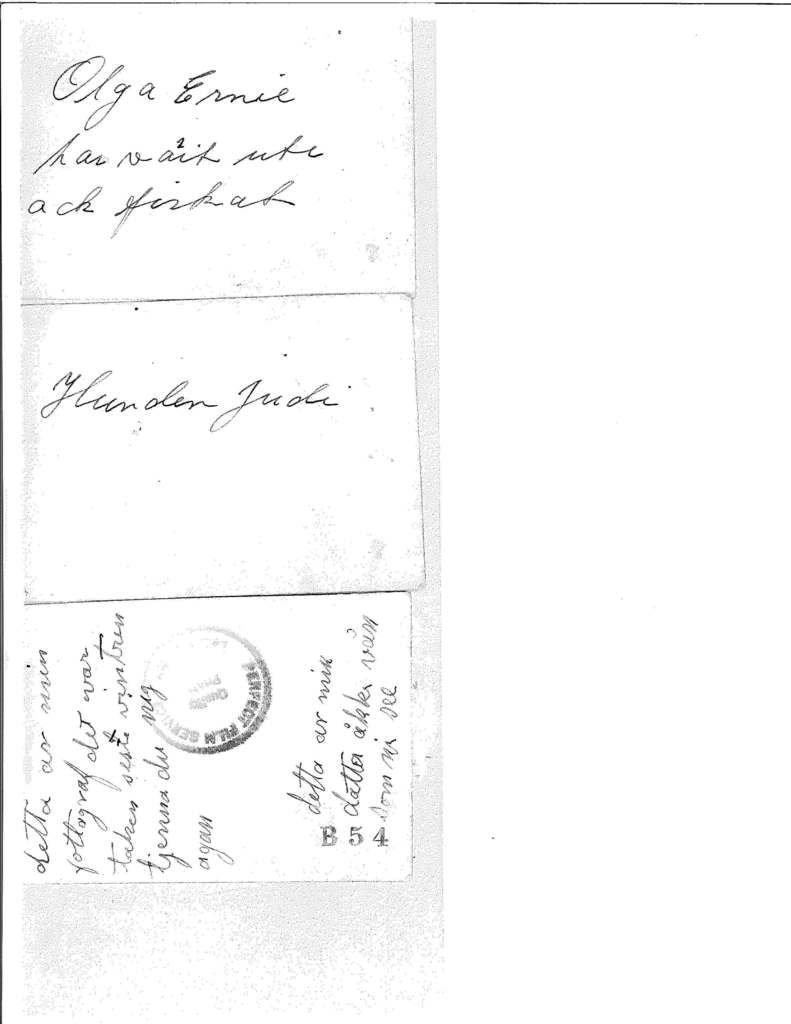
Som ni see.

John Cowan writes:

The good folks at Project Wombat have gotten a request for transcription and translation of Swedish text on the backs of some photographs, online here.

So far, they’ve gotten this feedback:

My best guesses:

  1. Olga Ernie har varit ute och fiskat ‘Olga [and] Ernie have been out fishing’
  2. The start of the word looks weird, but I think this should be Hunden Judi ‘The dog Judi’
  3. detta ar min fottograf det var taken seste vintern ljemna du mig agan. I am not sure what is meant here: It could be Detta är mitt fotografi. Det var taget sista vintern, lämnade du mig igen ‘This is my photograph. It was taken last winter, you left me again.’ Alternatively (although I doubt it): Detta är mitt fotografi. Det var tacken. Sista vintern lämnade du mig igen ‘This is my photo. This is how I was thanked [or ‘This was my reward’ / ‘This is how you thanked me”, depending on context]. Last winter you left me again.’

The three lines on the bottom just look like sentence fragments. My guess, with reservation from errors both in interpreting the letters and figuring out which Swedish words was meant:

detta ar min (detta är min) ‘this is my’

detta åkk vån (detta och vän) ‘this and friend’

som ni see (som ni ser) ‘as you can see’

I suspect this is some kind of Swedish dialect, which our good Hattics might be able to identify and properly translate. Alternatively, I suppose it could be archaic (but not too archaic), illiterate, or foreigner’s Swedish.

So what say you good Hattics?

Obnoxious.

A John Cowan comment reminded me I wanted to post about the word obnoxious, which must surely be one of the most difficult words to deal with in reading old documents, since its meaning has changed so confusingly. I discovered this while reading Peter Brown’s Through the Eye of a Needle; in the course of describing how Pope Gelasius helped keep the slaves working for their masters (so the grain would keep flowing from southern Italy to Rome), he writes:

Gelasius was told that many who became priests and deacons had been slaves. Many more had been obnoxii—farmers permanently tied to the estate on which they were registered as taxpayers. Clerical status freed them from these bonds.

Naturally, I wondered about obnoxii, so I looked up obnoxious in the OED (entry updated March 2004), and this is what I found:

Etymology: < classical Latin obnoxiōsus subject, subordinate < obnoxius exposed to harm, liable, answerable, submissive, subject to punishment ( < ob– ob- prefix + noxa hurt, injury (see noxious adj.) + –ius, suffix forming adjectives) + –ōsus -ous suffix.
In senses 4 and 5 probably immediately after noxious adj.

1.
a. Liable, subject, exposed, or open to a thing (esp. something actually or possibly harmful). (The usual sense before the 19th cent.) Now rare.
1572 R. Harrison tr. L. Lavater Of Ghostes i. x. 4 No kinde of men are more obnoxious to these kinde of things.
1578 J. Banister Hist. Man Proeme sig. Biij, They would not be able to hold their bowes, or cast their darts, for losenes of their ioints, through slippery humors so obnoxious to luxation.
1597 R. Hooker Of Lawes Eccl. Politie v. lxxxi. 267 Whom..they wold..make obnoxious to what punishment themselues list.
1621 R. Burton Anat. Melancholy i. i. iii. ii. 49 The finest wits..are before others obnoxious to it [sc. melancholy].
[…]
1682 J. Bunyan Holy War 243 The Town of Mansoul..now lyes obnoxious to its foes.
1712 J. Addison Spectator No. 441. ¶2 We are obnoxious to so many Accidents.
[…]
1810 R. Southey Curse of Kehama xiv. 154 That corporeal shape alike to pain Obnoxious as to pleasure.
1847 G. Grote Hist. Greece (1862) IV. ii. liv. 565 Obnoxious to general dislike.
1891 Law Times 91 406/2 A similar case, and is obnoxious to similar criticism.
1902 W. James Varieties Relig. Experience xi, The impulse..is..far too immediate and spontaneous an expression of self-despair and anxiety to be obnoxious to any such reproach.

b. Liable to do something. Obs.
1610 J. Donne Pseudo-martyr iii. 118 Our corruption now is more obnoxious and apter to admitte and inuite such poysonous ingredients.
[…]
1676 M. Hale Contempl.: 2nd Pt. 49 The time of Youth is most Obnoxious to forget God.
a1734 R. North Lives of Norths (1826) II. 72 They..were obnoxious to be taken up by every peevish sheriff or magistrate.

c. Without to or infinitive. Liable or exposed to harm. Obs. rare.
1612 J. Donne 2nd Anniv. in Progresse Soule 16 Thinke but how poore thou wast, how obnoxious, Whom a small lumpe of flesh could poyson thus.
[…]
1813 J. C. Eustace Tour through Italy I. xxv. 587 The inhabitants..would have been excusable if they had transferred the wreck of their property to some other less obnoxious quarter.

2. Subject to the rule, power, or authority of another; answerable, amenable to some authority; dependent, subject; (hence) submissive, obsequious, deferential (to a person). Obs.
1591 H. Savile tr. Tacitus Hist. ii. xix. 80 in Ende of Nero (1604) The Generals being obnoxious [L. obnoxiis ducibus], and not daring to prohibit it.
1591 H. Savile tr. Tacitus Ende of Nero: Fower Bks. Hist. ii. 75 One..of their owne creation, and therefore wholly obnoxious to them.
1656 B. Harris tr. J. N. de Parival Hist. Iron Age i. iv. xiv. 124 Hans-Towns,..partly..free; and partly Provinciall, and obnoxious [Fr. sujettes].
a1658 J. Cleveland Rustick Rampant in Wks. (1687) 437 That Kings are only the Tenants of Heaven, obnoxious to God alone.
a1695 A. Wood Life (1891) I. 397 Most of them..being sneaking and obnoxious, they did run rather with the temper of the Warden than stand against him.
[…]
1754 A. Murphy Gray’s Inn Jrnl. No. 72 Whether they are not obnoxious to the Association for preserving the Game.

3. Open to punishment or censure; guilty, blameworthy, reprehensible. Obs.
1604 R. Cawdrey Table Alphabet. Obnoxious, faultie, subiect to danger.
1610 J. Donne Pseudo-martyr xii. 353 The Doctrines of the Keyes..and all the ceremonies, which were the most obnoxious matters.
[…]
1719 D. Defoe Farther Adventures Robinson Crusoe 275 Our particular Persons were not obnoxious.
a1774 O. Goldsmith Misc. Wks. (1837) I. 535 A late work has appeared to us highly obnoxious in this respect.
1824 W. S. Landor Imaginary Conversat. I. vi. 73 No wise republic ought to be satisfied, unless she bring to punishment the individual most obnoxious.

4. Hurtful, injurious. Obs.
1638 T. Herbert Some Yeares Trav. (rev. ed.) 323 Crocodile..the most obnoxious of sea monsters.
[…]
1646 J. Hall Horæ Vacivæ 81 Unseasonable times of study are very obnoxious, as after meales.
[..]

5. Offensive, objectionable, odious, highly disagreeable. Now esp. (of a person): giving offence, acting objectionably; extremely unpleasant, highly dislikable. (Now the usual sense.)
1646 H. Burton Truth, Still Truth 30 Truth may be obnoxious to many, but never noxious to any.
1675 A. Wood Life & Times (1892) II. 318 A very obnoxious person; an ill neighbour; and given much to law sutes with any.
[…]
1841 E. FitzGerald Lett. (1889) I. 69 Carlyle..is becoming very obnoxious now that he has become popular.
[…]
1866 G. MacDonald Ann. Quiet Neighbourhood (1878) xi. 216 Thumb-marks I find very obnoxious.
1929 J. B. Priestley Good Compan. i. vi. 223 She referred to Unbelief as if it were a very obnoxious person who was in the habit of insulting her every morning and evening.
1944 E. Waugh Let. 29 Feb. (1980) 178 The more I tried to render myself obnoxious to him, the more he liked me.
1982 N. Sedaka Laughter in Rain (1983) ii. ix. 83 If he hated it he would push a button that made an obnoxious buzzer noise.
2000 F. Bleasdale Rubber Gloves or Jimmy Choos ii. 52 Sophie was in love with the most obnoxious guy I’d ever met.

The transitions between the senses are perfectly clear (liable to > subject to > open to punishment or censure; guilty, blameworthy > offensive, objectionable, odious), and yet I look at some of those early quotes and think “If I ran across that in my reading I would be completely at a loss.” When you’re used to the modern sense, it would take a lot of immersion in earlier usage to properly interpret “obnoxious to its foes,” “some other less obnoxious quarter,” “wholly obnoxious to them,” “obnoxious to God alone,” or “obnoxious to the Association for preserving the Game.”