AKSAKOV.

I’ve been reading Sergei Aksakov’s Years of Childhood, a wonderful memoir of growing up in the region of Ufa in the 1790s. Aksakov became a well-liked theater critic (and the father of two famous Slavophile sons, Konstantin and Ivan). He came to literary writing late in life, under the influence of Gogol; before writing the family chronicles and reminiscences for which he is mainly remembered, he produced books on fishing («Записки о рыбалке», 1847) and hunting («Записки ружейного охотника Оренбургской губернии», 1852) that were successful with both the public and with critics (the Russian Wikipedia entry says “Каждая главка книги представляла собой законченное литературное произведение” [‘every chapter was a finished literary work’]), and one of the many striking elements of Years of Childhood is the vivid portrayal of his excitement at discovering the world of nature and learning how to fish. (For an overlong and pedantic excursus on a fish name, see below the cut.)

D.S. Mirsky’s A History of Russian Literature has a full and admiring treatment of Aksakov:

The principal characteristic of Aksákov’s work is its objectivity. His art is purely receptive. Even when be is introspective, as he is in the greater part of Years of Childhood, he is objectively introspective. He remains unmoved by any active desire except to find once again the time that has been lost — “retrouver le temps perdu.” The Proustian phrase is not out of place, for Aksákov’s sensibility is curiously and strikingly akin to that of the French novelist… Like Proust, Aksákov is all senses. His style is transparent. One does not notice it, for it is entirely adequate to what it expresses. It possesses, moreover, a beautiful Russian purity and an air of distinction and unaffected grace that gives it a fair chance of being recognized as the best, the standard, Russian prose. If it has a defect, it is the defect of its merit — a certain placidity, a certain excessive “creaminess,” a lack of the thin, “daimonic,” mountain air of poetry…

The most characteristic and Aksakovian of Aksákov’s works is unquestionably Years of Childhood of Bagróv-Grandson. It is the story of a peaceful and uneventful childhood, exceptional only for the exceptional sensibility of a child encouraged by an exceptionally sympathetic education. The most memorable passages in it are perhaps those which refer to nature, for instance the wonderful account of the coming of spring in the steppe. … [I]f ordinary life, unruffled by unusual incident, is a legitimate subject of literature, Aksákov, in Years of Childhood, wrote a masterpiece of realistic narrative. In it he came nearer than any other Russian writer, even than Tolstóy in War and Peace, to a modern evolutionary, continuous presentation of human life, as distinct from the dramatic and incidental presentation customary to the older novelists.

I myself thought of Proust while reading Aksakov, as well as the opening pages of Joyce’s A Portrait of the Artist as a Young Man; few writers give so clear a picture of what it’s like to be a child.

[Read more…]

MED, VAY, DEVA, WHATEVER.

Serge Schmemann has an amusing column in the NY Times on the subject of American attempts to pronounce Russian names:

I saw it coming as soon as Tim Russert cornered Hillary Clinton into naming Vladimir Putin’s heir. She dodged, ducked and plunged into the now famous: “Med, vay, deva, whatever.” Nobody thought the worse of her. In fact, it drew one of the few sympathetic murmurs in the debate. Russian names are just not something most Americans can do. And if the blogs and online pronunciation guides I’ve checked are any indication, they never will.

One expert on National Public Radio thought that “Medvedev,” the way Russians pronounce it, is simply alien to the American tongue. But admitting that is alien to the American spirit, so there are many places to seek guidance. The Voice of America offers this phonetic spelling: “mehd-V(y)EHD-yehf.” They also provided a voice recording by a man who tried that — in all fairness, he does a pretty good “yehf.” But it’s not a sound likely to make President Dmitri Medvedev turn around….

One of the ways we compensate for the difficulty of foreign names is by adopting our own way of saying them. I once worked with an editor who spoke pretty good French, but used only the feminine article “la,” never “le.” Why, I finally asked? “Oh, it sounds SO much more French that way,” he drawled….

With time, we will learn to cope with Medvedev. We overcame Khrushchev, adopted Rostropovich and cheer hockey players, ballerinas and tennis stars. Medvedev is as elemental as “medved,” Russian for bear. So: Launch with “med” as in “he’s off his med”; put the accent on the “VEH” as in “venomous,” and trail off with a lazy “dev” with just a hint of “z” and “i”: “dziev.” Altogether now: “Med-VEH-dziev.” Whatever.

That “dz” sounds more Polish than Russian to me, but… wev.

WHO CAN SHAVE AN EGG?

Marina Warner has a fine essay in the TLS called “Babble with Beckett: How foreign languages can provide writers with a way out of the familiar.” Her main subject, obviously, is Beckett, but I want to highlight the material on Mallarmé, which I found surprising and hilarious:

It is interesting to think of Beckett’s precursors in relation to foreign languages: one of these, the poet Stéphane Mallarmé, like Beckett a supreme artist of linguistic, syntactical music, translated and taught English, and was so involved in aesthetics and semantics that he composed three rare and eccentric works on the language. It is in one of these, Thèmes anglais (English Lessons) that Mallarmé offers, as a phrase that falls from the lips of any English speaker born and bred: “Who can shave an egg?”. I had never heard this before (but that is true of most of the sayings in Mallarmé’s weird and wonderful English phrase book), but it struck me as clownish, a little alarming, and a minimalist’s maxim. Mallarmé’s love of English was not rooted in fluency or familiarity, but rather in something literally other or alien in the language used by the writers he admired – William Beckford, Edgar Allan Poe, Alfred, Lord Tennyson, Robert Louis Stevenson, and some rather lesser-known authors, such as Mrs Elphinstone Hope, whose forgotten story, “The Star of the Fairies”, Mallarmé translated in 1880. (He also left unfinished a mammoth anthology of English Literature.)…

Mallarmé shows an analogous desire for this erotics of language, a sense of language as sound, as music, as havoc, as nonsense, an understanding of modes of communication that defy semantics. He tried various approaches to overcoming his difficulties in teaching English. Hoping to capture the attention of his pupils, he turned to English’s near-unique richness of nursery rhymes and made versions of them in French prose – with extended, mock-earnest commentary and scrupulous grammatical notes, solemnly expanding on each rhyme’s possible significance. But his efforts did not meet with approval. In 1880, a government inspector, making the rounds of the classrooms, happened to enter M Mallarmé’s when the pupils were chanting a variation on “Tell Tale Tit”: “Liar liar lick spit / Your tongue shall be slit / And all the dogs in the town / Shall have a little bit”. The inspector was scandalized: “Since M. Mallarmé remains a professor of English”, he wrote, “Let him learn English . . . . It’s tempting to ask oneself if one is not in the presence of a sick man”.

It is a clue, however, to Mallarmé’s other pedagogical masterpieces that “Liar liar lick spit” is not the opening of the version that most English children know, which opens more usually, “Tell tale tit . . .”. Mallarmé’s failures in the classroom did not stem from lack of effort: Thèmes anglais contains a gathering of a thousand English phrases, proverbs, adages and saws, all conscientiously marshalled in order to illustrate a rule of English grammar: first the definite article, then the indefinite, first the possessive pronoun, then the relative pronoun, etc. The contrast between the austerely dry objective of the examples and their fantastical oddity, the disjunction between the scrupulous lexical and grammatical rigour and the free-association lexical chain of words, achieve an exhilarating absurdity. A native speaker of English would know precious few of these locutions at the very most, and use them – never. The ones that you might know you would find stale; and you would have done so then, in the late nineteenth century – since some of the proverbs Mallarmé cites were already archaic by the seventeenth. He was using an anthology he had come upon in Truchy’s bookshop to glean a myriad equivalents to “My postilion has been struck by lightning”, regardless of current usage.

What is entirely seductive about his lists is their irreducibly foreign character. But this strangeness turns his collection into a kind of prose poem, sometimes beautiful, sometimes weirdly comic: “Under water, famine; under snow, bread. / Prettiness makes no pottage”. These enigmas are offered to illustrate how, where French uses a definite article, English does without. Besides “Who can shave an egg?”, phrases such as “You can’t hide an eel in a sack” are included in order to illustrate the use of the indefinite article. The quirkiness of these rules inspires a riddling sequence:

It is hard for an empty bag to sit upright.
To cut down an oak and set up a strawberry.
Undone, as a man would undo an oyster.
You ask an elm tree for pears.
You shall ride an inch behind the tail.

These adages – proverbs or whatever – teeter on the verge of incomprehensibility. But their cumulative effect is melancholy: failure stalks them, regardless of syntactical exactitude.

She goes on to discuss his love of alliteration, assonance, onomatopoeia, and other forms of “semantic synaesthesia,” and the whole essay is full of good things, but I couldn’t resist Mallarmé’s notion of how to illustrate English usage. (Via wood s lot.)

BIBLIODYSSEY: THE BOOK.

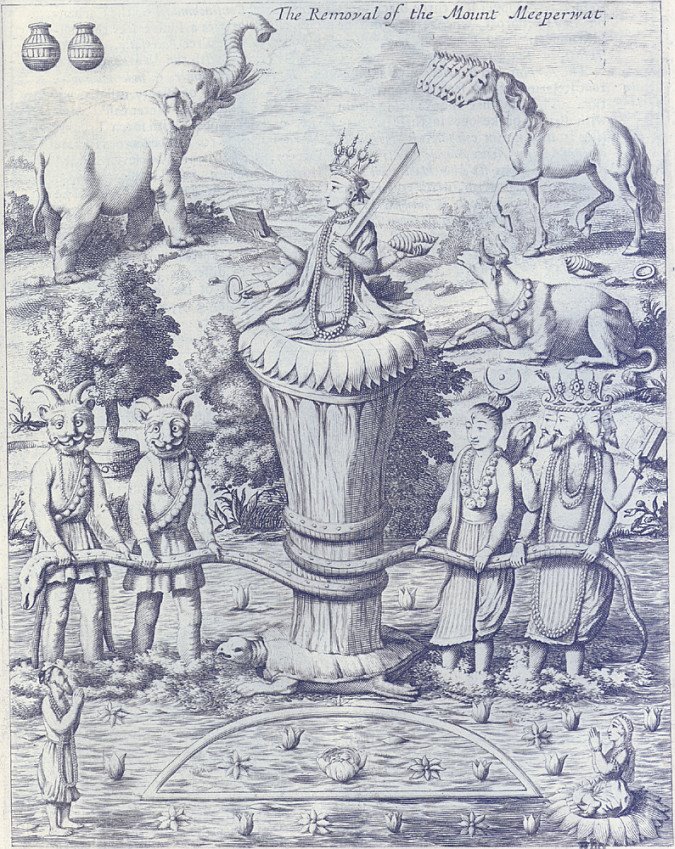
Anyone who loves old book illustrations should have BibliOdyssey (“Books~~Illustrations~~Science~~History~~Visual Materia Obscura~~Eclectic Bookart”) among their bookmarks, and anyone who loves the site will be glad to know that FUEL has published a book by its pseudonymous creator, who has changed his moniker from peacay to PK for the occasion. Since they were kind enough to send me a copy, I can report that it is well worth having even if you read the website assiduously, because about half of it has never appeared there, and the text is almost entirely new—not to mention, of course, that it’s great to have these gorgeous images in permanent form, well reproduced in a beautifully made book. PK himself says:

Ultimately, I envisage a threefold purpose in compiling a book of diverse illustrations — the simple pleasure of eye candy; the evocation of a deeper interest in an historical, artistic or scientific subject; and for use as a projectile, to be thrown at those who would say there is nothing worthwhile to be found on the internet, or who question why anybody would want to spend so much time in front of a computer screen.

To which I say, Amen.
Here’s a sample of the value added by the text; the images The Idol of Vistnum in his third Transformation and The Removal of the Mount Meeperwat (1672) are available at his site, but the book gives the background:

[Read more…]

JOHN DOE.

This Wikipedia article has an extensive list of “Informal names for unknown or unspecified persons in various countries/regions” [As of 2017, replaced by this article, “List of terms related to an average person”]; as I said in the MetaFilter thread where I found it, it’s annoying that all the names are lumped together with only occasional attempts to distinguish legal terms (John Doe) from colloquial ones (Joe Blow), but it’s still a lot of fun. Where else are you going to learn that the term in the Faroe Islands is Miðalhampamaður?

LILLY’S GRAMMAR.

Via dirk at Pepys Diary, this delightful excerpt from George Borrow’s Lavengro:

The very first person to whose care I was intrusted for the acquisition of Latin was an old friend of my fathers, a clergyman who kept a seminary at a town the very next we visited after our departure from ‘the Cross.’ Under his instruction, however, I continued only a few weeks, as we speedily left the place. ‘Captain,’ said this divine, when my father came to take leave of him on the eve of our departure, ‘I have a friendship for you, and therefore wish to give you a piece of advice concerning this son of yours. You are now removing him from my care; you do wrong, but we will let that pass. Listen to me: there is but one good school-book in the world – the one I use in my seminary – Lilly’s Latin grammar, in which your son has already made some progress. If you are anxious for the success of your son in life, for the correctness of his conduct and the soundness of his principles, keep him to Lilly’s grammar. If you can by any means, either fair or foul, induce him to get by heart Lilly’s Latin grammar, you may set your heart at rest with respect to him; I, myself, will be his warrant. I never yet knew a boy that was induced, either by fair means or foul, to learn Lilly’s Latin grammar by heart, who did not turn out a man, provided he lived long enough.’

My father, who did not understand the classical languages, received with respect the advice of his old friend, and from that moment conceived the highest opinion of Lilly’s Latin grammar. During three years I studied Lilly’s Latin grammar under the tuition of various schoolmasters, for I travelled with the regiment, and in every town in which we were stationary I was invariably (God bless my father!) sent to the classical academy of the place. It chanced, by good fortune, that in the generality of these schools the grammar of Lilly was in use; when, however, that was not the case, it made no difference in my educational course, my father always stipulating with the masters that I should be daily examined in Lilly. At the end of the three years I had the whole by heart; you had only to repeat the first two or three words of any sentence in any part of the book, and forthwith I would open cry, commencing without blundering and hesitation, and continue till you were glad to beg me to leave off, with many expressions of admiration at my proficiency in the Latin language. Sometimes, however, to convince you how well I merited these encomiums, I would follow you to the bottom of the stair, and even into the street, repeating in a kind of sing-song measure the sonorous lines of the golden schoolmaster. If I am here asked whether I understood anything of what I had got by heart, I reply – ‘Never mind, I understand it all now, and believe that no one ever yet got Lilly’s Latin grammar by heart when young, who repented of the feat at a mature age.’

If you wish to perfect your own education by memorizing Lily (the more usual spelling), here‘s an edition on Google Books.

PETTIFOGGER.

Another fun etymology (via wordorigins.org): pettifogger (“a lawyer who engages in petty quibbling and cavilling, or who employs dubious or underhanded legal practices”) is explained by the OED as simply petty plus the earlier fogger, and the OED says of the latter:

[Of somewhat obscure history; but prob. derived from Fugger, the surname of a renowned family of merchants and financiers of Augsburg in the 15th and 16th c.

The name passed as an appellative into several European langs. In German fugger, fucker, focker (see Grimm) has had the senses ‘monopolist, engrosser’, ‘usurer’, ‘man of great wealth’, ‘great merchant’, and, in certain dialects (doubtless originally through ironical use), ‘huckster, pedlar.’ Kilian 1598 has Flem. focker ‘monopolist, universal dealer’ (monopola, pantopola), giving fuggerus and fuccardus as popular mod.L. equivalents; and in mod.Du. rijke fokker is an avaricious rich man. Walloon foukeur and Sp. fúcar are contemptuous designations for a man of great wealth. A ‘petty Fugger’ would mean one who on a small scale practises the dishonourable devices for gain poularly attributed to great financiers; it seems possible that the phrase ‘petty fogger of the law’, applied in this sense to some notorious person, may have caught the popular fancy, and so have given rise to the specialized use in sense 1. …]

1. A person given to underhand practices for the sake of gain; chiefly, a contemptuous designation for a lawyer of a low class. Usually preceded by petty (see PETTIFOGGER). Obs.
1576 FLEMING Panopl. Epist. 320 As for this pettie fogger, this false fellowe that is in no credite or countenance. […]

Yes, the jokes write themselves.

Update (May 2024). The OED revised the entry in 2016; here’s the new etymology:

Probably < Fogger, former spelling in English texts (see note) of Fugger, the surname of a family of wealthy mercantile bankers and venture capitalists from Augsburg, Germany, in the 15th and 16th centuries.

Notes

Historical background.

The Fugger family, operating largely through their agents in Antwerp, controlled much of the European economy in the 16th cent. and were widely criticized for unethical business practices, such as attempting to secure a monopoly on copper, selling indulgences and benefices, and petitioning the Pope to rescind the prohibition of usury.

Forms of the surname.

For evidence of the spelling Fogger of the surname in the mid 16th cent., compare e.g.:

1553 Item, the King’s Lettres Patentes of Securitie..for the payment of cxxvijml and ijc florens Carolyns of Flaunders money to the Foggers.
in Acts Privy Council (1892) vol. IV. 423

The surname is recorded in English documents from the mid 16th cent. in a wide variety of forms, as e.g.: Folker, Fouger, Fouker, Foulker, Fowker, Fuggar, Fukker, Fulcor, Fulker, all recorded from 1546–53, and a number of these have also given rise to common nouns in English (compare fulker n., fowker n., fooker n.). This variation in the form of the name probably partly reflects the range of spellings and pronunciations of the surname in German (compare the variants Focker, Fucker (both recorded from the early 16th cent.)) and Dutch (compare Fokker (1632 or earlier)). Additionally, a number of forms probably reflect assimilation to the English surname Fulcher, Fulker, Folker, Fulger, Foulcher, etc., which is recorded from the 12th cent. onwards.

Parallel nouns in other European languages.

The surname also came to be used as a noun (usually in a similar derogatory sense) in a number of European languages. Compare e.g. Dutch †focker, †fokker monopolist, universal dealer (1588 in Kiliaan), a contemptuous term for a wealthy man, ‘moneybags’ (1621; usually in rijke fokker), German †Fucker monopolist, engrosser (1691 or earlier; also 1520 in Luther, apparently denoting a corrupt dealer, merchant, or financier; also in form Fugger), and also Spanish fúcar (1615), French regional (Belgium) foukeur, both in sense ‘rich man’.

Semantic development in English.

The specific application of this word and of the compound pettifogger n.¹ to dishonest lawyers appears not to be paralleled in other European languages; the motivation for its development is unclear.

In sense 2 perhaps reinforced by association with fog v.¹ 3.

And the first citation is now:

1564 I knowe them verie well, thei are two pettifoggers in the lawe.
W. Bullein, Dialogue against Fever Pestilence f. 12ᵛ

THE PAIN OF LANGUAGE REVIVAL.

Lameen of Jabal al-Lughat has a thoughtful post pointing out that “Not everyone welcomes language revitalisation efforts”:

Apart from anything else, it often implies that a major decision taken by you or your parents – to speak to the children in a different language – was wrong, and, by increasing your exposure to the endangered language in question, puts you in a position where you can’t help but notice that this decision’s implications are nearly irreversible. (I have speculated that this might be one reason for the less than enthusiastic reaction of some of the first speakers to have brought up their kids as Arabic monolinguals to my arrival in Tabelbala.)

He goes on to quote a moving post by the Scottish writer Ken MacLeod that moves from Gaelic-English bilingual roadsigns to a meditation on “forgetting the language, leaving it to dwindle in the Sunday-morning sermon and the ceilidh and the old folks’ private talk.” Well worth the read, as are Lameen’s recent posts on Kwarandzie.

THE CLAY-FREE OFFICE.

Continuing to read Ostler (see this post), I just hit this passage I have to share with you. He’s been discussing the spread of Aramaic, which replaced the earlier lingua franca Akkadian thanks to the Stalinesque Assyrian policy of deporting entire conquered populations (many of which were from the west and spoke Aramaic) and relocating them elsewhere in the empire, and the repercussions of the new ink-and-papyrus writing system it brought in its wake:

The short-term practical advantages of the new media (less bulk, greater capacity) must soon have made an impression. A new word for ‘scribe’ came into use in Akkadian, sēpiru. as opposed to the old ṭupsarru, ‘tablet writer’, which went right back to the Sumerian word dubsar. Pictures of scribes at work from the mid-eighth century show them in pairs, one with a stylus and a tablet, the other with a pen and a sheet of papyrus or parchment. As with the onset of computers, good bureaucrats must have ensured that the old and the new coexisted for a long time: the ‘clay-free office’ did not happen in Assyria till the destruction of the empire by the Medes in 610 BC. ([footnote]In Babylon some diehards were still writing Akkadian on clay six centuries later.)

AMORGOS.

Twenty years ago I bought and read The Hill of Kronos by Peter Levi. This memoir of Levi’s love affair with Greece and its literature formed, along with The Flight of Ikaros by Kevin Andrews and of course lascivious old Henry Miller’s irresistible The Colossus of Maroussi, the basis of my image of Greece before my own visit (which thoroughly lived up to expectations).

In the first chapter, after saying “it was not difficult to meet poets in Athens, since they all went to the same three or four cafes and bars,” Levi introduces one of the heroes of the book, who recurs throughout as a touchstone of Greekness:

When I arrived I walked straight to Flocca and left a message with a waiter for Nikos Gatsos. He was in the cafe and he came over. He was the most enchanting and unexpected friend I had ever made. His appearance is that of an elephant of brilliant intelligence and extraordinary kindness. In forty years he has moved cafes once, when the old one was pulled down, and tables twice. His smile is seductive, his shoulders hunch, his eyes are hooded but distinctly mischievous. His conversation, which ranges widely, is humourous and subtle, pausing like a river to take in any strange object that presents itself. He knows more about poetry than anyone else I have ever met. He is admirably mysterious.

He makes his living as a song-writer, which means that over many years the Greeks have had better-written songs than anyone else, and by translations. As a poet he claims to have been on strike for forty years, but his long early poem, Amorgos, named after an island he has never seen, is one of the master works of the century; and if ever I knew a poet, and a great poet, he still is one. He was the son of an innkeeper in what was then a remote village in Arkadia. George Seferis once said to me that the only person alive he envied for his grasp of the Greek language was Gatsos. There is an element of surrealism in Amorgos, like cold water so refreshing it makes one gasp. But his language, the form of his speech, has a continuity with folk-songs. In his childhood that was still a living language:

And because of this I would have you, young men, to go down naked into the rivers
With wine and kisses and leaves in your mouth
To sing of Barbary as the carpenter follows the track of the wood’s grain
As the viper moves out from the garden of the barley
With her proud eyes furious
And as the strokes of lightning thresh the young

The translation I quote is by Sally Purcell.

Needless to say, when I got to Greece I set about looking for a copy of Amorgos, and I found one in Iraklion (a city to be recommended mainly for its proximity to Knossos—if you want a Cretan city to hang out in, I highly recommend Khania), a slender and beautiful Ikaros reprint. But my Greek, while decent, is not really up to long semi-surrealist poems, and the book languished on my shelves until today, when I discovered an online translation by Vasili Stavropoulos (from the Australian “literary arts magazine” Masthead). The translation is decent and the notes are useful; I would expand on the final one to say that Golfo, an 1893 play by Spiridon Peresiadis that was wildly popular in the first half of the last century (you can read a summary of the plot here), is the play the traveling troupe kept performing in O Thiasos, the four-hour epic of Greek history by director Theodoros Angelopoulos, and the villain who lures the heroic shepherd Tasos away from his beloved Golfo is named Kitsos, which can be confusing if you’re thinking of it when you run across the mention of that name in the poem—fortunately, Stavropoulos is there to point out that this is another Kitsos, a Greek chieftain who fought the Turks and whose mother threw stones at the river so it would allow her to cross and save him.

If you’re interested in the original Greek text, it’s online here.

Addendum. Here’s the start of the Stavropoulos translation:

With their homeland tied to the sails and their oars hanging in the wind
The sailors slept peacefully like wild beasts dead in sheets of sponge
But the eyes of the seaweed are turned to the sea
In case the southerly brings them back with lateens freshly painted
And a single lost elephant is always worth more than a girl’s breasts that sway
Only to ignite in the mountains the roofs of deserted churches with the yearning of the evening star
So that birds may ripple at the masts of the lemon tree
With the steady white breath of the new walk
And then shall come breezes swan’s bodies that remained spotless tender and motionless
Among the steamrollers of the shops among the vegetable gardens’ cyclones
When the women’s eyes became charcoals and the hearts of the chestnut vendors were broken
When the harvesting ceased and the hopes of the crickets began.

And here’s the passage quoted above in Purcell’s translation:

So that is why my fearless young men with the wine the kisses and the leaves in your mouth
I want you to come out naked to the rivers
To sing of Barbary as the woodworker seeks the mastic tree
As the viper passes through the fields of barley
With her proud eyes furious
And as the lightning threshes youth.

Update (Oct. 2020). POEM OF THE MONTH: “Amorgos” by Nikos Gatsos.