ON NOT LICKING YOUR FILL.

I ran across a Russian proverb I couldn’t interpret, «Не наелся — не налижешься» (literally “[if/since] you didn’t eat your fill, you won’t lick your fill”), so I asked Sashura, who can explain everything, and he explained it. The idea is that if you haven’t taken care of the important stuff, there’s no point worrying about the details, and if you have, there’s no need to, as in this quotation from Dombrovsky in which Maxim watches men he had trained: “Всё, что он вложил в этих людей, они показывали, и нечего суетиться в последнюю минуту. Не наелся, не налижешься. Люди были хорошо одеты, обуты, вооружены.” [These men were showing everything he had put into them, and there was nothing to worry about at the last minute. You didn’t eat your fill, you won’t lick your fill. The men were well dressed, shod, armed.] There are any number of variants: “Чего не съешь, тем не налижешься,” “Чем не наелся, тем не налижешься,” “чего не наелся, того не налижешься,” “коль не наелся, так и не налижешься,” “Если не накушаешься, то и не налижешься,” and the more elaborate “Если ложкой не наелся, языком не налижешься” [‘if you didn’t eat your fill with a spoon, you won’t lick your fill with your tongue’].
The interesting thing, and what leads me to post about it, is that some googling revealed that it’s not just Russian but more widely Eastern European: this message board has the following exchange:

Liliana Boladz: Co sie nie najesz, to sie nie nalizesz.
I am not sure, if this is a Polish proverb.
Dodo Kaipdodo: There sure is the Lithuanian “Ko neprivalgei, neprilaižysi”; the nights before exams, when trying not to fall asleep “catching up”, I used to remember that and go to sleep, finally…

Anybody know of equivalents in other countries?

EMERY.

Nigel McGilchrist’s LRB review of David Abulafia’s “magisterial” The Great Sea: A Human History of the Mediterranean (I confess I’m a sucker for words like “magisterial”) got me so fired up I went to the Amazon page, noticed that the Kindle price was under ten dollars for this $35 book (Amazon’s selling the hardcover for $21.69, but who needs another hardcover cluttering up the place?), and succumbed to the lure of getting it instantly, even though I won’t get around to it for a while. I suspect it will eventually provide me with a number of posts, but the word that inspired me to write this one doesn’t even occur in the book—it’s from a section of McGilchrist’s review where (in the time-honored tradition of scholarly reviewers) he complains about what the book doesn’t cover:
In his discussion of the prehistoric era, Abulafia mentions obsidian, whose importance to early human communities cannot be overestimated, and points out that the training of tool-makers ‘in what seems a deceptively simple craft was no doubt as long and as complex as that of a sushi chef’. Obsidian is cited a dozen times in the first thirty pages, but never so as to explain or to pursue satisfactorily its immense significance. Obsidian is the oldest widely ‘traded’ commodity in Mediterranean history. It occurs naturally and is easily accessible at only two major sites within the sea – the volcanic islands of Lipari near Sicily, and Milos in the Aegean (that is, if we exclude minor sources such as Nisyros and Gialí) – and yet it is found at the lowest levels in archaeological sites all over the Mediterranean from Malta to Crete, and from Lemnos to Egypt. Thanks to its distinguishing characteristics we can recognise the source of the material in each case, and can deduce that from perhaps as early as 8000 BC, obsidian from Milos was being transported around the Aegean islands, presumably in sail-less coracles.

[Read more…]

MORE ON MACHINE TRANSLATION.

Even though I’m deeply skeptical of the idea that automatic translation will ever be more than barely adequate (which is often good enough, as I insisted here), I continue to be interested in discussions of the topic, and Konstantin Kakaes has one at Slate called “Why Computers Still Can’t Translate Languages Automatically.” I like the fact that he emphasizes the difficulties without pooh-poohing the whole idea; in his conclusion, he writes:

Automatic semantic tagging is obviously hard. You have to deal with things like imprecise quantifier scope. Take the sentence “Every man admires some woman.” Now, this has two meanings. The first is that there exists a single woman who is admired by every man. […] The second is that all men admire at least one woman. But how do you say this in Arabic? Ideally, you aim for a phrase that has the same levels of ambiguity. The point of the semantic approach is that rather than attempt to go straight from English to Arabic (or whatever your target language might be), you attempt to encode the ambiguity itself first. Then, the broader context might help your algorithm choose how to render the phrase in the target language.
A team at the University of Colorado, funded by DARPA, has built an open-source semantic tagger called ClearTK. They mention difficulties like dealing with the sentence: “The coach for Manchester United states that his team will win.” In that example, “United States” doesn’t mean what it usually does. Getting a program to recognize this and similar quirks of language is tricky.
The difficulty of knowing if a translation is good is not just a technical one: It’s fundamental. The only durable way to judge the faith of a translation is to decide if meaning was conveyed. If you have an algorithm that can make that judgment, you’ve solved a very hard problem indeed.

DOWN WITH PALATALIZATION!

A recent post at Anatoly’s blog (now called просто здесь красный, где у всех голубой, a quote from Aquarium‘s song “8200”) shows an absolutely hilarious sign held up by a protester: “Мы за пересмотр итогов палатализации” [We are for a reconsideration of the results of palatalization]. [Photo now available here.] Unfortunately, unless you’re familiar with the Slavic first, second, and third (no Wikipedia article, for shame!) palatalizations, you’re going to have a hard time seeing the humor, but for those who are, Anatoly’s thread is funny enough I think it’s worth posting.

Addendum. Don’t miss Bathrobe’s long comment below (May 15, 2012 09:54 AM) on Mongolian scripts and dialects and the history of the split between Buryat and Mongolian!

Update (2013). John Cowan writes to say: “Anatoly’s blog no longer shows the famous picture, but it is available at
http://img-fotki.yandex.ru/get/6304/24332511.8a/0_6f9ba_76f4ae5d_XXL.” I’ve added a note in the post accordingly.

IGNORANT BLATHERING AT THE NEW YORKER.

Joan Acocella is the longtime dance critic of the New Yorker. I imagine she’s a fine dance critic; I don’t know or care anything about dance, so I wouldn’t know one way or the other, but when I’ve dipped into her pieces from time to time she’s seemed literate and sensible. She writes book reviews as well (she has a PhD in comparative literature, so she even has academic credentials in case any were needed). However, when it comes to the study of language, she is an utter ignoramus, which makes it surprising that the New Yorker allowed her to run on for pages and pages blathering about it in the latest issue. I’m as mad about it as I was a decade ago about David Foster Wallace’s similarly dumb essay for Harper’s; I don’t have the time or energy to go into similar detail, but I hope to give good grounds for thinking the New Yorker shouldn’t have published it.

In the first place, like DFW, she’s using a review assignment as a pretext for an extended rant that only occasionally bothers to make contact with the book allegedly under discussion. This kind of thing is fine when the reviewer is a specialist in the field and can provide helpful context and relevant information; that’s half the fun of reading the NYRB and LRB. But Acocella is not an expert; she knows no more about the study of language than I do about the history of dance, which is to say a mix of clichés and misunderstandings. I suspect Acocella would be upset if she were to read what purported to be a review of a book on dance in which the reviewer jovially passed along a lot of nonsense about the Ballets Russes and George Balanchine picked up at random over the years, yet she apparently feels no shame about doing the same herself.

After setting up the straw men she will be manipulating for the rest of the review (“many English speakers have felt that the language was going to the dogs,” while “[t]o others, the complainers were fogies and snobs”), Acocella turns to telling us about Fowler, Orwell, and (of course) Strunk and White (that’s E. B. White, of the New Yorker) as though we’d never heard of them before. After 1,300 words of this, she moves on to Webster’s Third New International Dictionary, which DFW called “the Fort Sumter of the contemporary Usage Wars” (see this LH post). As she says at great length, it aroused considerable controversy and gave rise to the American Heritage Dictionary and its “usage panel,” which started out pretty conservative but over the years has started to reflect general usage much better. She then has 800 words on slang and “U and Non-U,” for no apparent reason except that she finds them interesting. She is then ready to provide her magisterial judgment on the subject at hand: prescriptivists are snobbish but descriptivists are self-righteous, and the author, an example of the latter, is just full of mistakes. “Hitchings applies a great deal of faulty reasoning, above all the claim that since things have changed before, we shouldn’t mind seeing them change now.” What’s wrong with that, you ask? I won’t try to summarize her “argument”; here it is in all its glory:

[Read more…]

NEW OLD LANGUAGE.

The Independent has a story by David Keys, “Ancient language discovered on clay tablets found amid ruins of 2800 year old Middle Eastern palace,” that will make the heart of any aficionado of the ancient Near East beat faster. Not that they’ve discovered an epic poem, or even a laundry list—it’s just a bunch of names—but we aficionados will take what we can get, and this is actually pretty exciting:

Evidence of the long-lost language – probably spoken by a hitherto unknown people from the Zagros Mountains of western Iran – was found by a Cambridge University archaeologist as he deciphered an ancient clay writing tablet unearthed by an international archaeological team excavating an Assyrian imperial governors’ palace in the ancient city of Tushan, south-east Turkey.
The tablet revealed the names of 60 women – probably prisoners-of-war or victims of an Assyrian forced population transfer programme. But when the Cambridge archaeologist – Dr. John MacGinnis – began to examine the names in detail, he realized that 45 of them bore no resemblance to any of the thousands of ancient Middle Eastern names already known to scholars. […]
Typical names, borne by the women – the evidence for the lost language – include Ushimanay, Alagahnia, Irsakinna and Bisoonoomay.

A full account is published in MacGinnis’s “Evidence for a Peripheral Language in a Neo-Assyrian Tablet from the Governor’s Palace in Tušhan” (JSTOR) in the current issue of the Journal of Near Eastern Studies. Look for those names to start turning up in historical bodice-rippers any moment (given the instant-publishing world we live in). And there are lots of tablets still to be examined; maybe that epic will turn up after all. (Thanks, Conrad!)

SYM AND EM.

I’ve always been a little confused by the words sympathy and empathy, and I’m pretty sure I’m not alone. I’m even more confused after reading this passage in Jenny Turner’s LRB review [archived] of Together: The Rituals, Pleasures and Politics of Co-Operation by Richard Sennett:

In the present book, one key contrast is between sympathy — ‘I feel your pain’ — and empathy, ‘maintaining eye contact even while keeping silent, conveying “I am attending intently to you” rather than “I know just what you feel” . . . Both . . . convey recognition, and both forge a bond, but the one is an embrace, the other an encounter.’

To both my wife and me, this seems completely wrong; “I know just what you feel” is what we mean by empathy, not sympathy. But this could be an age thing, a US/UK thing, or a shared idiosyncrasy. As usual, I turn to the Varied Reader; does the quoted passage agree with your sense of the words? If not, how do you distinguish them?

THE TRANSLATOR IN THE TEXT.

I’ve finally gotten to Rachel May’s The Translator in the Text: On Reading Russian Literature in English, which Noetica gave me for Christmas, and it’s just as good as I expected. I’ve read the first of its four chapters, a history of Russian translation into English, and I thought I’d share some of the nuggets that made me put a pencil mark in the margin. On the difference between the English (who tended to get excited about Russian lit when the Russians did something to attract their attention, and then drop it) and the Americans:

The American response to Russian literature followed a different chronology…. There were neither the great surges of russophobic curiosity nor the periods of indifference, but rather a steady increase of interest, particularly in Turgenev. Americans had earlier access to Russian literature: in the 1870s there were probably three times as many American as British translations, and their quality was generally superior as well. Many works by Gogol and Tolstoy and several novels by Turgenev, including Dmitri Roudine, Fathers and Sons, and Smoke, appeared in New York in the 1860s and 1870s, a decade or more before London publishers brought them out. What is more, they were reviewed in all the major American journals. Especially in the case of Fathers and Sons (trans. 1867), the reviews were enthusiastic about the novel’s aesthetic as well as documentary merits. …

Americans’ affection for Russian literature was not only more constant but more broadly based. George Sand once commented to the itinerant Russian intellectual M.M. Kovalevsky that the English praised Turgenev highly but read him little; Kovalevsky found, on the other hand, that “even middle-class Americans” knew Turgenev’s works.

But even some Yanks had strong negative reactions; Maurice Thompson called Tolstoy “a rich man who prefers to live in brutal vulgarity” and his novels “as dirty and obscene as the worst parts of Walt Whitman’s ‘Leaves of Grass.'” (I wonder if that sold some extra copies?)

Dostoevsky was little known until Constance Garnett (long idolized for her Turgenev translations) got around to him; “when Garnett’s translation of The Brothers Karamazov finally appeared in 1912, it caused an enormous sensation,” and she followed it with “eleven more volumes of Dostoevsky’s works in the next eight years. ‘Constance Garnett’s translations of Dostoyevsky’s major works was, at least in its immediate effects, one of the most important literary events in modern English literature,’ her biographer wrote.” And then she did the same for Chekhov: “As with Turgenev and Dostoevsky, Garnett did not limit herself to a few of Chekhov’s works but heaped upon the English reading public thirteen volumes of stories, two of plays, and one of letters, thereby creating a rich humus within which the cult could develop. And develop it did. The appearance of Garnett’s Chekhov collection has been likened in impact to her Brothers Karamazov…” And I can’t resist mentioning that Oxford’s first curriculum of Slavic studies, established in 1887, was called “Lithu-Slavonic Languages.”

But I have one bone to pick. On page 43 she writes: “New translations of earlier Soviet works began to appear: Bely’s Petersburg came out in English in 1959…” What could she have been thinking? The first Russian edition of Bely’s masterpiece came out in 1916, and he was about as un-Soviet a writer as could be imagined. But even Jove and bonus Homerus nod, and this is otherwise a wonderful book—I’m very much looking forward to the rest of it.

ADHERENT.

The latest xkcd is a jolly and cleverly done parody of the Major-General’s Song from The Pirates of Penzance; the only thing that bothers me is that in the fourth panel from the end, the line “By dubbing econ ‘dismal science’ adherents exaggerate” uses an unacceptable (to me) distortion to cram the word adherents into the meter. That was my first reaction, anyway; it then occurred to me that this might be yet another linguistic evolution that had snuck up on me while I was looking the other way. It’s perfectly clear that it’s not a traditional pronunciation—Merriam-Webster has two, \ad-ˈhir-ənt\ (add-HERE-ənt) and \əd-ˈhir-ənt\ (əd-HERE-ənt), while the OED has four alternatives, all with penultimate stress (they add -HAIR- variants to M-W’s pair)—but maybe some people are starting to say ADD-herent, with initial stress, and Randall Munroe is one of them (and his poetic license will not have to be revoked). So: anybody out there say ADD-herent or find it an acceptable/normal alternative?

FASHIONS IN GIVEN NAMES.

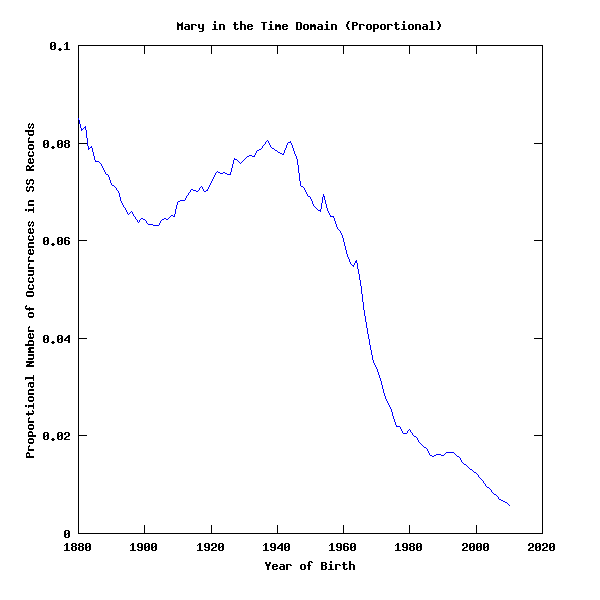
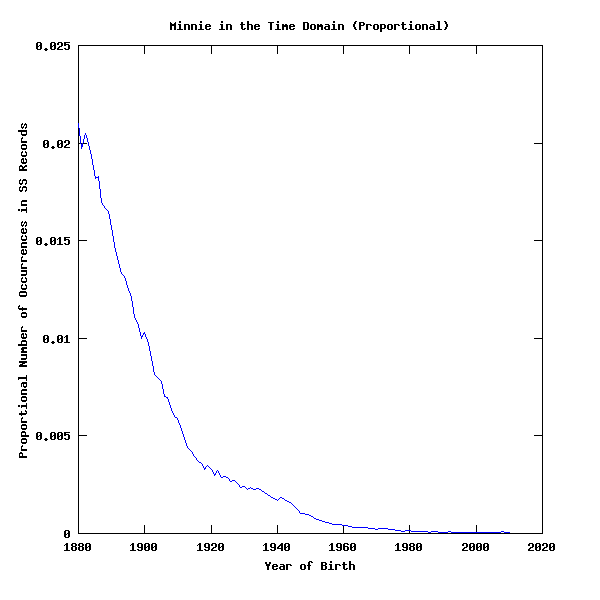
Mark Liberman at the Log has a post on “the changes over time in fashions for given names. It’s obvious that things change — but it’s less obvious whether these changes are cyclic. It makes sense that out-of-fashion names might come back after a generation or two — but does this really happen on a regular basis?” He crunched some data and his answer, rather surprisingly, is no: “Basically, it seems that names come and names go, and sometimes names come and go — but it doesn’t seem to happen very often that names come and go and come again, at least within the 131-year time period covered by this dataset.” It’s sad (to me) to see the popularity of a fine old name like Mary plummeting on his corrected graph during the decades after WWII, though its decline hasn’t been as drastic as that of Minnie (which essentially vanished over the course of the 20th century).

In the comments, Mark Etherton linked to Douglas A. Galbi’s Given Name Frequency Project (“A given name, which forms part of a contemporary personal name, is generally given to a person shortly after birth, and given names are seldom changed. Given names thus provide a means for disciplined, quantitative study of information economies across major social, economic, and technological changes”), which features a paper called “Long-Term Trends in Given Name Frequencies in England and Wales” that I recommend to your attention—it has tables of frequencies going back a thousand years, and the findings are remarkable: “since early in the nineteenth century, the frequency distribution of personal given names in the UK has evolved differently than it did over the previous eight centuries. Simple indicators of this change are the trend in the popularity (frequency relative to the total number of names in the sample) of the most frequent names. The popularity of the most frequent name, the three most frequent names, and the ten most frequent names show no trend from circa 1300 to 1800. Since then all these measures have dropped dramatically….” The conclusion has some interesting thoughts:

Although recent work on personal given names in England has emphasized name-sharing practices for understanding the frequency distribution of given names (Smith-Bannister, 1997), name-sharing practices have little direct relationship to the frequency distribution of names. Naming a significant share of children after parents, or after godparents, are equally consistent with a high or low popularity of the most frequent names. Similarly, having names freely chosen, i.e. chosen in absence of norms giving high value to the name of a person in a specific social position in relation to the person to be named, could produce high or low popularity of the most frequent names. The most that can be said for name-sharing is that a norm of naming after parents creates additional inertia in name popularity. Name popularity and its long-term evolution depend on factors other than name-sharing. The evolution of the name frequency distribution over time is a complicated dynamic system. Such systems can, in some circumstances, be highly sensitive to a particular factor, while in other circumstances, be totally unaffected by that factor. Moreover, boundary conditions, such as a small share of naming done in violation of prevailing norms, can determine the over-all state of the system.

Analysis of long-term trends in personal given names in the UK suggests that significant changes in the information economy occurred in conjunction with the broad social and economic changes called the Industrial Revolution. The Industrial Revolution is associated with more rapid growth in population. The population of England in 1800 was about 50% greater than in 1300, while its population in 2000 was about six times greater than in 1800. The Industrial Revolution is also associated with much more rapid growth in income: real economic income per person probably increased by about a factor of four from 1300 to 1800, and by about a factor of 100 from 1800 to 2000. But populations of much different sizes show similar naming patterns …, and it is not clear how the level of income itself would effect naming. The Industrial Revolution also produced major changes in social networks and the social context of personal activity….

At any rate, do check out the name tables.