MIMESIS.

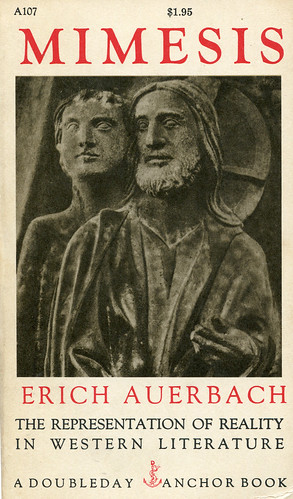
I recently picked up a copy of Erich Auerbach‘s Mimesis: The Representation of Reality in Western Literature, a classic I’ve meant to read for decades now. I don’t know if Auerbach is still much read; I suspect his traditional approach, with its deep philological knowledge and casual allusiveness (he wrote it in in Istanbul, where he had fled from the Nazis and where he had to make do with the scanty resources available to him, but he writes as if he had entire libraries at hand), is long out of fashion, but it’s very much to my taste. I was introduced to the book by Susan Cherniack, one of the finest scholars and people it has been my privilege to know (it is not to academia’s credit that she is not still in academia), but in those days I was immersed in Indo-European and had no time for it. Now I have the time (and more knowledge and maturity), and I should be able to get more out of it.

At any rate, my question to the assembled multitudes is: if you are familiar enough with the titular word to have a pronunciation for it, what is it? I’ve always been torn between /maɪ’miːsɪs/ (my-MEE-sis), the traditional anglicized form, and /mɪ’meɪsɪs/ (mih-MAY-sis), the classicizing form I’m guessing most Americans use (if they use the word at all); I presume Auerbach said /’mimesɪs/ (MEE-may-sis), with stress on the first syllable (which is the way my German dictionary has it), and modern Greeks say /’mimisis/ (MEE-mee-sees), but we can rule the latter two out of court as unbearably pretentious on English-speaking lips. (Wikipedia tells me the Russian equivalent of “mimesis” is мимесис or мимезис, with the stress on the first syllable.) I lean toward the second version (mih-MAY-sis), despite my usual preferences, because that’s how Susan said it, but I’m curious about other people’s usage.

Incidentally, the copy I got is not the currently available Deluxe 50th Anniversary Edition (9.2 x 6.2 x 1.3 inches, Shipping Weight: 2 pounds) but the good old Anchor paperback, small enough to fit into my pants pocket. Books have gotten both too expensive and too big.
DIGITIZING BALINESE.

A post by Grace Neveu and Jake Johnson at Archive.org reports on a project to digitize all of Balinese literature (as this brief notice says, “They are in the running for being the first culture to have their entire literature go online, even current writings and lectures”):

The documents are centuries-old lontar palm leaves incised on both sides with a sharp knife and then blackened with soot…. The writings consist of ordinary texts to sacred documents on religion, holy formulas, rituals, family genealogies, law codes, treaties on medicine (usadha), arts and architecture, calendars, prose, poems and even magic. The estimated 50,000 lontars are kept by members of the Puri (palace) family and high priests to ordinary families. Some are carefully kept as family heritages while others are left in dirty and dusty corners of houses. Digitizing the lontars makes them available to scholars and students and salvages the documents from getting destroyed by insects or humidity, as many already have.

At the link you can see images of lontars, watch a video of a performance, and follow further links. Thanks, Yoram!

POSTDICTION AND THE BRAIN.

Burkhard Bilger’s article on David Eagleman in the April 25 New Yorker is one of the most interesting things I’ve read in a long time; I haven’t even finished it yet, but I had to post a passage from page 59 that provides a nice use of the word postdiction (see this LH post from a year ago) and a linguistic example. Eagleman studies our sense of time and how the brain creates it:

Like Crick, Eagleman was fascinated by consciousness. He thought of time not just as a neuronal computation—a matter for biological clocks—but as a window on the movements of the mind. In a paper published in Science in 2000, for instance, Eagleman looked at an optical illusion known as the flash-lag effect. The illusion could take many forms, but in Eagleman’s version it consisted of a white dot flashing on a screen as a green circle passed over it. To determine where the dot hit the circle, Eagleman found, his subjects’ minds had to travel back and forth in time. They saw the dot flash, then watched the circle move and calculated its trajectory, then went back and placed the dot on the circle. It wasn’t a matter of prediction, he wrote, but of postdiction.
Something similar happens in language all the time, Dean Buonomano told me. If someone says, “The mouse on the desk is broken,” your mind calls forth a different image than if you hear, “The mouse on the desk is eating cheese.” Your brain registers the word “mouse,” waits for its context, and only then goes back to visualize it. But language leaves time for second thoughts. The flash-lag effect seems instantaneous. It’s as if the word “mouse” were changed to “track pad” before you even heard it.

The article is wonderfully written (“The most recent neuroscience papers make the brain sound like a Victorian attic, full of odd, vaguely labelled objects ticking away in every corner”), and you won’t regret devoting a chunk of your day to reading it.

UH-OH!

An entertaining Ask MetaFilter thread analyzes the burning question: what did you say as a kid when someone got in trouble? The poster remembers something like “aww-dee!” and is looking for support, since “no one I’ve brought this up to has ever remembered it”; one person agrees (“Definitely heard “aww-dee” as a kid, but I don’t remember where”), but most have never heard of it and contribute their own remembered outcries, which make for enjoyable reading. My pick of the crop:

South Georgia, early-mid nineties: “Ah-woo-woo!” I’ve actually discussed this with peers raised in less rural parts of the world, and they’ve all agreed that this is really weird.
posted by honeydew

Yes, it is indeed really weird. (None of them are familiar to me, but I am a visitor from the Pleistocene; I believe we just said things like “Uh-oh, you’re gonna get it!”)

ANATOLY LIBERMAN AND THE WAIFS.

The waifs of English, that is, the words nobody’s been taking care of, etymologically speaking. Alyssa Ford has a good piece in the Star Tribune of Minnesota about Anatoly Liberman, a linguist trying to finish “his masterwork, a multi-volume dictionary on the history of common English words”:

As the professor labors on his dictionary in the solitude of his library carrel, his wordy colleagues from around the world are closely following the progress of the “Liberman Project.”

“At conferences, we ask each other how Anatoly is doing on the dictionary, how close he is,” says Joan Houston Hall, the editor of the DARE at the University of Wisconsin-Madison. “We are all rooting for him.”

“The work he’s doing is extremely important to our understanding of the history of English,” says Steve Harris, adjunct associate professor of German and Scandinavian Studies at the University of Massachusetts-Amherst. He added that if Liberman is able to complete the dictionary, he could very well be added to the pantheon of great lexicographers including Murray, Walter Skeat and Noah Webster. …

…As he dug further, Liberman discovered that about 1,000 common English words — mooch, nudge, man, girl, boy, frog, oat, witch and skedaddle among them — seemed to be highly confused or all but untraceable, as if they magically appeared in English, pouf! “It was like finding all these waifs of English who run around with dirty T-shirts and no shoes and no one takes care of them,” says Liberman. “And suddenly I wanted to build a nice, warm orphanage for the parentless words, for the boys and girls and heifers too.”

It would be a new kind of word-origin dictionary, one focusing on the most problematic, misunderstood words in English. Liberman knew right away it was a magnificent, massive project that could take 30 years or longer to complete.

Assuming he completes it, it will of course be far too expensive for anyone but libraries, but I will definitely drop by my local library to leaf through it. I do love a good, meaty etymology.

THE BOOKSHELF: YOU ARE WHAT YOU SPEAK.

Robert Lane Greene is an international correspondent for The Economist and one of the moving spirits behind their language blog, Johnson (where his latest post is called “Anti-Peeve Peeve Friday”); last year I praised his column on the best books about language, and now Sophie Roell has a good interview with him at The Browser in which he again discusses language books (like me, he’s a fan of Guy Deutscher and Arika Okrent, but he thinks more highly of Steven Pinker than I do). So I was expecting to enjoy the copy of his new book You Are What You Speak: Grammar Grouches, Language Laws, and the Politics of Identity that the good folks at Delacorte sent me—but I wasn’t expecting to enjoy it as thoroughly as I did. He covers pretty much all the ground I was vaguely thinking of covering in the language book I’ve been vaguely thinking of writing, and does it so well and so convincingly my impetus has been drastically diminished. This is the book I will be recommending to people who want to know how to think about language without getting themselves and others more agitated than is necessary—or, as he puts it in his charming preface, “Too many people are too angry about language too much of the time. That time that could be better spent listening, learning, and enjoying the vast variety of human language around them.”

He starts off discussing some general myths about language (giving Bill Bryson a well-deserved whack along the way), then moves on to “A Brief History of Sticklers,” starting off with the wretched Lynne Truss—”She doesn’t do subtlety”—and leaping back to Caxton’s late-fifteenth-century complaint about varying ways to say ‘eggs,’ moving forward again through Dryden, Swift, Lowth, and the usual twentieth-century suspects, two of whose names rhyme with “funk” and “blight” (“But on what basis could White condemn ‘hopefully’ while accepting the new extension of ‘to dress’? We never find out. Peeves are like that: my peeves are law, yours are unhealthy obsessions”). Then he delves into academic linguistics, where he is fortunate to have Mark Liberman (of the Log) as a guide; my complaint about the chapter, which is also my only complaint about the book, is that he jumps from Saussure straight to Chomsky, ignoring the entire storied history of American linguistics, that beautiful and varied garden that Chomsky stomped into submission and replaced with his identical rows of plastic flowers. In fact, he has a horribly misleading paragraph on page 73 that begins “Having killed behaviorism with this kind of dry wit, and having also published his revolutionary 1957 book Syntactic Structures, Chomsky launched linguists on the task of trying to construct ‘grammars’ of languages.” This is the exact reverse of the truth; it is the prior tradition of American linguists, led by the great Leonard Bloomfield, that worked on constructing scientific grammars of languages. Chomsky had no interest in grammars of anything but English, as illustrated by a remark of his Liberman passes on to Greene (on pages 64-65) to the effect that “it wouldn’t matter a whit to have descriptive grammars of all the world’s languages (and that one might as well survey the location of every blade of grass on MIT’s campus).” But that’s not Greene’s fault; he’s simply repeating what passes for the Story of Linguistics these days, from which the pre-Chomsky tradition is effaced much as the pre-Mao founders of the Chinese Communist Party like Li Dazhao and Chen Duxiu were written out of its history once Mao became the Great Helmsman. Other than that, the chapter is well done, and ends with an excellent discussion of diglossia that includes this telling anecdote about Arabic:

In the first full-length Arabic conversation I ever had, with two young Egyptians I met in South Africa who didn’t speak English, I could speak only fusha (not yet having begun learning a modern colloquial Arabic dialect). They tried to respond in kind. But it was a clumsy exchange on both sides. They mixed in not only typically Egyptian pronunciations (such as gadiid for jadiid, “new”) but “wrong” ones in fusha that came from their dialect, such as munazama for munadhama (“organization”). Though I struggled to remember some vocabulary, in other ways my fusha was better than theirs. (On the other hand, a sociolinguist might say my overall performance was much worse; fusha is utterly inappropriate for late-night hotel-bar drinks. I must have sounded something like a professor lecturing to them.)

The fourth chapter, “More Equal than Others: How All Languages Can Express Almost Everything,” starts with a discussion of this hilarious YouTube clip, which was new to me: “I’ve probably watched the video fifty times, and it makes me laugh every time. I’ve quoted the video so often that a friend suggested I call this book Shit Flyin’ in My Mouth.” But he deplores the racist commentary on YouTube and the fact that the video is titled “Ghetto Reporter,” saying that the reporter’s sudden change from standard English to his native (Louisiana) dialect is exactly comparable to what happens to his Danish-born wife, who speaks “incredibly fluent English” but “as soon as she stubs her toe on our bed frame, she always says the same thing: For Satan!, cursing in Danish.” He goes on to discuss the Ebonics controversy, Whorfianism, and other touchy topics with admirable good sense.

The fifth chapter is about linguistic nationalism, and of course covers Hebrew, with this delightful bit:

Hebrew even has—and this should not surprise readers of this book so far—declinist sticklers. “Ben Yehuda would be dismayed by the demotic Hebrew spoken today,” said the Israeli author and journalist Hillel Halkin. Another Semiticist scholar, Ullendorff, scoffs:

Modern oddities like the grammatically impossible mekir instead of makkir and similar monstrosities had not arisen in Mandatary Hebrew, and I am glad that it is left to those who nowadays watch over the health of contemporary Hebrew either to come to terms with such horrors or to endeavour to discard them.

Just a hundred years old, and already being ruined by the kids! A normal language indeed.

He also discusses the former Yugoslavia, with some vivid quotes from linguist Robert Greenberg, who specializes in the region. When giving a speech in Zagreb, “Much to my embarrassment, my interlocutors chastised me for using the Serbian form jul ‘July’, rather than the Croatian form srpanj. To add insult to injury, one of the Institute’s staff then took me aside and made me repeat after her all the proper Croatian forms for all twelve months.” And:

Having landed at Sarajevo [Bosnia] Airport in June 1998, I struck up a conversation with one of the airport’s land crew. Her first comment was that she was impressed with my skills in the Bosnian language. Frankly, I had had no idea that I was even capable of speaking Bosnian…

The next morning I crossed the inter-entity boundary… in order to catch the bus to Belgrade. In Bosnian Serb territory, I spoke the same language I had used the day before, only now I was treated as a Serb. When the Yugoslav border guards singled me out for extra questioning upon my entry into Serbia, the bus driver told them to let me through, because he considered me to be one of theirs.

The sixth chapter is on “The Folly of Legislating Language Rules,” dealing with Turkish, French, and German before wading bravely into the touchy subject of Chinese and Japanese and their possible Romanization. Chapter Seven is about nationalist pressures in English and French (on the latter: “It is no longer seen as the done thing to attempt to destroy indigenous languages, and the attitude of the government in Paris has become what some call ‘hostile tolerance’ of the regional languages”), with good discussions of Breton (he visits Brest and tries to find someplace where Breton is in use) and the Midi, about which I learned something from this paragraph:

Finally, there are the Romance dialects: Picard, Gallo, Nissart, Occitan, Provençal, and the like. These are all closely related to French, and their speakers often themselves regard them as little more than substandard “patois.” They are different enough from French to be reasonably classified as separate languages, however, and they do have their ardent backers. But they are either small—as with the northern varieties—or divided, as in the south. “Provençal” and “Occitan” are dialects of each other, or Provençal is a dialect of Occitan, or they are the same thing, depending on whom you ask. But the supporters of “Provençal,” in the southeast and near the Alps, are associated with the political right, and the fans of “Occitan,” in the central south and southwest, are tied to the left. They don’t get along and so have been unable to form a strong united front for the single strongest and uniquely French Romance tongue after French itself.

The final chapter is on “Better Ways of Thinking About Language,” and it is so wise and eloquent that it should be required reading in schools (and definitely for politicians). A couple of passages I particularly like:

In thinking about languages themselves, most people succumb to a simple vision that might be called languages-as-boxes. Just as boxes have a rigid geometrical shape, people want a language to have one rigid, supposedly perfectly “logical” variety: the correct one handed down in prescriptive dictionaries and grammars. Moreover, people also want or expect those boxes to correspond exactly with national boundaries. Only one variety of one language called German should be the language of exactly one country called Germany, which should include all and only German-speakers; and so on for Italians, French, and so forth. One crucial step to realizing the boxes metaphor in the real world is to create “nation-states,” largely achieved in Europe but elusive in most of the rest of the world. The other step is to standardize the language so that everyone within their borders speaks the same dialect; variation is to be scorned, as against unity and patriotism, against the nation itself. This metaphor is taught, overtly or tacitly, to children in schools when they are told to stop speaking their Alsatian/Cajun/ Scots/Ebonics and start speaking the “real” language, the only one worthy of the name and the one that defines the society the children live in.
* * *
Language is not law; it is in fact a lot like music. Speech is jazz—first you learn the basic rules, and then you become good enough to improvise all the time. Writing is somewhat more like classical composition, where established forms and traditions will hold greater sway. But nobody sought to punish Franz Liszt for using Hungarian folk songs in his compositions, nor to put Jimi Hendrix in jail for playing “The Star-Spangled Banner” on his guitar (though Jimi did spark indignation). We need to put away the idea that someone speaking a way we don’t like is some kind of offense against the public order.

If you think any of the statements I’ve quoted are too simple, rest assured that he’s probably gone on to qualify them. He has the journalist’s knack for the pithy and memorable line, combined with an admirable respect for the messy and endlessly disputed nature of the human world. I hope the book sells like hotcakes and stays in print forever, so I can go on recommending it to anyone who wants to know how to think about language.

THE MISSING RADICAL.

I keep meaning to post about a recent essay of Lameen’s at Jabal al-Lughat, “In search of the missing radical: a piece of Berber historical morphology.” He starts out:

Berber normally has no glottal stops (ء = ʔ) – in fact, Chafik suggested that this was why North Africa favours the Warsh reading of the Qur’an, in which most glottal stops are omitted. However, it turns out* proto-Berber did have glottal stops – and you can still see their footprints on the verbal system.

His explanation of the footprints is fascinating, and as he says, “an interesting small-scale parallel to the story of Saussure’s laryngeals.”

INTERVIEW WITH JOHN EMERSON.

“spat Gavin” of There could be snakes in here has an interview with frequent LH commenter John Emerson, who has provocative things to say about philosophy, economics, and academia, among other things; I will quote this final bit:

I am not working much. I do plan to put out more collections, but my energy flags. Your interest is a positive factor, believe me. The topics would be Lao Tzu and Chinese philosophy, the rise of Genghis Khan, the origins of Chinese shi poetry (the Cao clan), Populism, and the general philosophical stuff you’ve showed interest in.

…and add my plea for the book on Inner Eurasia promised in the preface to his 2007 collection Substantific Marrow (see this LH review). John has accumulated a unique mix of knowledge about this too little studied region, and I would like to see it on my bookshelf, so if reader interest is a positive factor, here’s another dollop of it.

REVIER.

I’ve finally started reading Vasily Grossman’s Жизнь и судьба (keeping the Chandler translation Life and Fate by my side to help resolve difficult passages), and I’ve run across an interesting German etymology. Grossman uses the German word Revier (in Cyrillic transliteration) in the military sense ‘sick quarters, sick-bay,’ and of course I was curious about the etymology. I looked it up in my ancient and crumbling Lutz Mackensen, and it turns out it was originally borrowed from French rivière ‘river(bank)’! (The French word is from Latin riparia, an adjective to ripa ‘bank.’) Apparently the basic sense was ‘district, quarter’ (especially ‘hunting ground’), and in a military context revierkrank was used to mean ‘sick enough to be confined to quarters,’ whence in the nineteenth century Revier itself developed the sense ‘sick quarters.’ Etymology can be a twisty business.

UNFORGIVING YEARS.

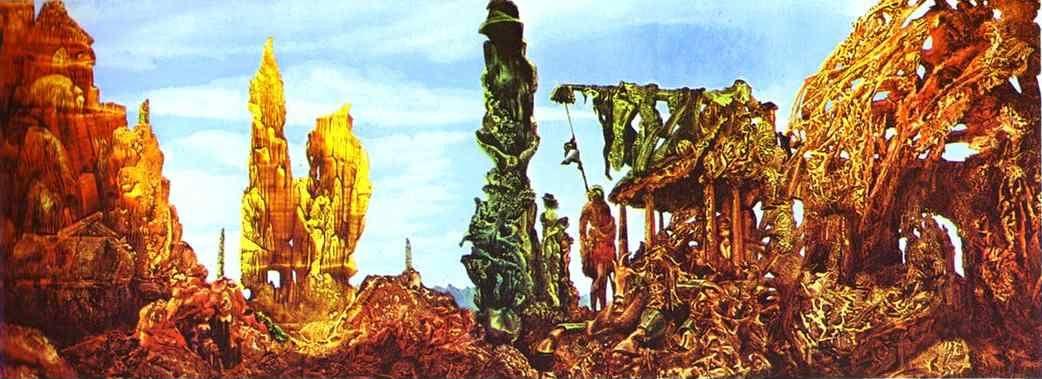
Last year I wrote briefly about Victor Serge’s novel The Case of Comrade Tulayev; at that time I said I was very much looking forward to Serge’s World War II novel Unforgiving Years, and I have now finished reading it (in Richard Greeman’s translation from Serge’s Années sans pardon; does anyone know if it has been translated into Russian?). It’s a strange, vivid nightmare of a novel; J. Hoberman, in his NYRB review, says it reminds him of “Max Ernst’s epic canvas Europe After the Rain, painted between 1940 and 1942, when the artist, like Serge, was on the run from France to the New World” (here‘s an image of Europe After the Rain II, not to be confused with the 1933 Europe After the Rain I, painted on plywood previously used by Buñuel for his hilarious and violently controversial movie L’Âge d’Or), and I think that’s a valid comparison. Both novel and painting are strange, somewhat off-putting, and hard to turn away from. The novel’s four sections are set in Paris before the war, in Leningrad during the siege, in Berlin as it was falling in 1945, and in Mexico after the war (where Serge himself wound up after the U.S. refused him entry); the characters are, as in the earlier book, disillusioned revolutionaries, but this novel concentrates on psychology rather than politics, and it’s filled with dream imagery and wild metaphors. It also has a fair amount of poetry, and as a service to readers who know Russian I will identify the Blok poem quoted on page 83 as “Рождённые в года глухие” (the lines translated in the text are “В сердцах, восторженных когда-то,/ Есть роковая пустота”) and the poem quoted on page 115 as Iosif Utkin’s “Слово Есенину” (the quoted lines are “Кому нужны бокалы,/ Бокалы без вина?,” “Есть ужас бездорожья,/ И в нем – конец коню!/ И я тебя, Сережа,/ Ни капли не виню,” and “А кроме права жизни,/ Есть право умереть”); does anyone recognize the lines translated on page 162 as “Keep quiet, dissemble, make secret/ Your feelings and your thoughts” are from Tyutchev [see MV’s comment below]. (There really should be a footnote on page 109 explaining to the non-Russian reader the story of “Lermontov’s classic poem ‘Three Palms'” (Russian text): the palms complain to God that they are growing uselessly in the desert, whereupon a caravan shows up and rests beneath their welcome shade… and the following morning chops them up for firewood before moving on. This imagery is relevant to just about everything Serge ever wrote.)

A passage on page 220 could serve as an epigraph for the novel: “the devastated cities are sisters, Stalingrad, Warsaw, Coventry, London, Lübeck, and this city [Berlin] too: they could all be mistaken for one another in a photograph.” The fact that a Russian communist, immediately after the war, could write sympathetically about Berlin and its suffering inhabitants will give you some idea of Serge’s uniqueness, and of why he was so roundly ignored by pretty much everyone for decades. I’m glad he’s finally getting his due.