TRANSLATION AND THE INTERNET.

An interesting discussion by Linda Schenck, a Swedish-to-English translator, of some problems she encountered in trying to translate Ett oändligt äventyr [An Endless Adventure] by Sven-Eric Liedman. The book begins (in her translation):

In 1749, Carolus Linnaeus journeyed to study southern Sweden. He arrived at Vittskövle, in the eastern province of Skania, on the evening of May 26th. There, he noted, the sand pinks spread a lovely scent and “the nightingales performed all evening”.

Linnaeus spent two days in Vittskövle. May 28th was a Sunday. Before going to mass he made an excursion to the sandy fields that still open out toward the sea east of the village, known today as “the Mölle mound”. He made some remarkable discoveries there. The first and most astonishing was an Astragalus Arenarius, an herbaceous plant “no one has previously found in Sweden”. Here it grew abundantly “between the grove of firs and the dunes of sand”. Apparently it had already been identified in England, as he added: “How it was able to make its way from England to Vittskövle is extremely difficult to figure”.

Since the plant came from England (according to Linnaeus), she quite naturally wanted to know how you say sandvedel (modern Swedish for Astragalus arenarius) in English. The rest of the piece recounts the saga, and the surprising discovery, that ensued; she concludes:

This mini-adventure into the realms of knowledge took place between 26 and 29 January 2002, all thanks to the “information technology” that on other days and for other reasons is the bane of my existence. Twenty-five years ago this kind of correspondence and research might have taken weeks to accomplish. Difficult to say whether that would have made it more or less exciting, but I do feel extremely privileged to be party to these erudite exchanges on subjects a life without translation would never open up for me. There are also translations I take on today that I would have found too daunting from the research point of view in the days before the Internet. I suppose, too, there are books written because the research can be done much more expeditiously than ten years ago. Perhaps to some small extent those advantages balance the verbiage the information society generates. On my good days, I believe so.

I apologize in advance for the ugly white-on-brown graphics, but the story’s worth it. (Via wood s lot.)
GEOFFREY CHAUCER HATH A BLOG.

I keep forgetting about this, but fortunately No-sword wrote about it and reminded me: this is well worth your attention. Yeah, yeah, Chaucer blogs, got the idea… but it’s really well done and funny as hell. Geoffrey gives advice:

Sir –
Ich wishe for ad[v]yce in the matter of fashion and armes. Ys it verrily a mistake to wear a lilyflour in my helm? (Ich have a shylde of golde.)
Thopas
Mon Sire Thopas,
By seinte Jerome, finallye someone who kan spelle! Messire Thopas, yow seem a man fair and gent, and Y sholde muchel relish for to tellen yowre tale. Ich shalle have myne peple calle yowre peple. As for the lilye? It dependeth how whethir yow wolde ben ‘easte coaste’ or ‘weste coaste.’
Le Vostre G

Geoffrey on the Perle poete (and I do mean “on”):

O, thatte olde colde tyme on the montayne, when we ownede the worlde and nothynge semed wronge! Indede – the makere of Perle was “wyth” me…
Depe did we stepe ourselves in drinke. Thenne – and by the waye ich assume thou wilt kepe this knowledge from dere Philippa! – we dide thynges that wolde make Alanus of Lille his hede explode. We dide thynges that wolde make Peter Damyan spontaneouslie combuste. We dide thynges that are notte even listede in Burchard of Worms. Rim, ram, ruf!
At morwe-tyde, he sayde me, “Thou knowst I am not of the scole of Edwarde II.”
“Me neithere,” quod I “‘Tis nobodies privitee but oures.”

[Read more…]

DONGXIANG.

An article by Jim Yardley in today’s NY Times reports on the Dongxiang, an Islamic population in China’s Gansu province whose isolation has preserved their culture and language, which is part of the Mongolian branch of the Altaic family. Yardley writes:

For years, many Chinese scholars assumed that the Dongxiang descended from the Mongol soldiers in Genghis Khan’s army who eventually settled in Gansu during the 13th century when the Mongols ruled China under the Yuan Dynasty. But their exact origins were never fully known, an uncertainty that fed an inferiority complex.

“A man once asked me, ‘Where do the Dongxiang come from?’ ” said Ma Zhiyong, a historian who grew up in the county but moved to the provincial capital, Lanzhou, as a teenager. “I was 18 or 19, and couldn’t answer the question. I was ashamed.”

Mr. Ma decided to look for an answer. Over several years, he scoured research libraries in Gansu, talked to other scholars and studied old maps. He found that some Dongxiang villages shared names with places in Central Asian countries like Uzbekistan.

He also found shared customs. He said peasants in Uzbekistan and Dongxiang both learn to cut a slaughtered chicken into 13 pieces. He found that Dongxiang people described themselves as sarta, a term that once referred to Muslim traders in Central Asia.

There was even a physical similarity, as many Dongxiang look more like people from Central Asia, as opposed to Han Chinese.

Mr. Ma decided that the story about Genghis Khan’s army was only half right. Some of the Dongxiang ancestors were Mongol soldiers. But he concluded that many others were a diverse group of Middle Eastern and Central Asian craftsmen conscripted into the Mongol army during Khan’s famed western campaign. They brought several languages and, in many cases, a strong belief in Islam.

Mr. Ma said that generations of intermarriage, including marriages with local Han Chinese and Tibetans, resulted in a new ethnic group and language.

I presume the “new language” part refers to the fact that (by Ethnologue’s reckoning) 30% of the vocabulary is Chinese; it would be interesting to know how different it is from other Eastern Mongolian languages. I refer the curious reader to Oliver Corff’s nicely done page on “The Dongxiang Mongols and Their Language”; Corff says “This short article can hardly be called more than an appetizer for the interested reader,” but he’s too modest—it’s a lot more than I expected to be available for such an obscure language.

SCDORIS.

My lovely wife sent me a NY Times story about a legally blind musher named Rachael Scdoris who finished the 1,100-mile Iditarod race early Saturday, asking the simple but deadly question “Whence the name Scdoris?” Damned if I know. I’ve scoured the internet and found others with that name (there were several of them in Nebraska in 1920), but nothing at all on the history of the name and family. Come on, this isn’t Smith or Jones; how come none of the news stories address this issue? I haven’t even got a clue as to what language it might be adapted from. But surely one of my far-flung readers will know. My thanks in advance for relieving my mind of this pressing concern.

Addendum. Ben of Positive Anymore (“American Dialects, Yiddish, New Yorker Cartoons, Pop Music – they all go together, right?”) has done yeoman work on this and discovered that Scdoris is a deformation of Sedoris (c is an easy mistake for e, but how did it stick?), and the latter is a transmogrification of the German surname Sartorius! This makes me very happy, both because I don’t have to lose sleep worrying about the origin of the strange-looking name and because it’s such an interesting derivation. Sartorius! Whoda thunkit? (Sartorius, incidentally, is Latin for ‘tailor,’ and I presume it was originally a fancified version of Schneider. It’s also the origin of the Faulknerian surname Sartoris.)

THE NAMES OF BATTLES.

I’ve been reading about the American Civil War, and I think I’m finally getting a grasp of how it went, at least in the eastern theater—the interaction of strategy and politics and geography and personality that produced those battles whose names are so familiar to Americans: Gettysburg, Antietam, Bull Run… But there are onomastic problems here. The easiest is the existence of duplicate names; the South tended to name battles after nearby towns or railway junctions (Sharpsburg, Manassas, Leesburg) and the North after natural features of the landscape (respectively Antietam [Creek], Bull Run, Ball’s Bluff—there’s a convenient list here). That was no problem for me even as a child, familiar as I was with pairs like Tokyo/Edo, Bangkok/Krung Thep, and Thailand/Siam. (To this day I love alternate names for places.)

What really threw me for a loop was examining a series of battle maps and realizing that the Battle of Chancellorsville (May 1863) and the Battle of the Wilderness (May 1864) were fought over almost the same patch of ground (the later battle was a little to the west). Furthermore, the Battle of Fredericksburg (December 1862) and the Battle of Spotsylvania (May 1864) were fought just a few miles away; all four are part of the same national military park and all four involved the same strategy (the North trying to cross the Rappahannock and get within striking distance of the Confederate capital Richmond). It would make a lot more sense if the first two were called First and Second Wilderness (like First and Second Bull Run/Manassas). Similarly, Chickamauga (September 1863) and Chattanooga (November 1863) were just a few miles apart and part of the same series of events; they could perfectly well be called First and Second Chattanooga. But of course people don’t give things names with a view to the convenience of future students.

Still, you’d think they’d make the relations clearer in modern reference books. Battle maps tend to be either abstract (rectangles representing the opposing divisions, labeled with the names of commanding generals, and arrows showing the motion during a specified time frame) or lavishly pictorial (little blue and grey mannikins shown in action poses advancing or retreating across a lovingly rendered landscape); in both cases, there is usually no indication of wider context (what state are we in again? which direction is Washington?) and only the most cursory idea of what role the battle played in the larger scheme of the war. If I were making a Civil War atlas, I’d have plenty of “context pages” that showed the areas of battles on a wider grid, so you could see at a glance how Fredericksburg related to the Wilderness, and I’d create nice names for larger elements of the war that would allow you to make sense of the battles (the Rappahannock Campaign, the Push to Georgia, etc.).

And why “Chancellorsville,” anyway? As far as I know, there was no -ville at all, just an inn called the Chancellor House in the middle of the Wilderness. Questions, questions…

PARKOUR.

Via a MetaFilter thread I learned of the existence of Parkour:

Le Parkour (also called Parkour, PK, l’art du déplacement, free-running) is a physical discipline of French origin. It is an art form of human movement, focusing on uninterrupted, efficient forward motion over, under, around and through obstacles (both man-made and natural) in one’s environment. Such movement may come in the form of running, jumping, climbing and other more complex techniques.

It doesn’t interest me as an activity, but the word is notable in that it’s a borrowing from French in nonstandard spelling, something of a rarity. As a result, when you look at it in English it’s not clear how to pronounce it; if it had the standard spelling parcours that wouldn’t be a problem. (Frankly, I find this kind of respelling with k for c pretty ugly, but I guess that’s the point, or part of it. Epater le fuddy-duddy, you know.)
Incidentally, the same MeFi thread introduced me to the word thixotropic; see my first comment therein for more.

SIRAYA ONLINE.

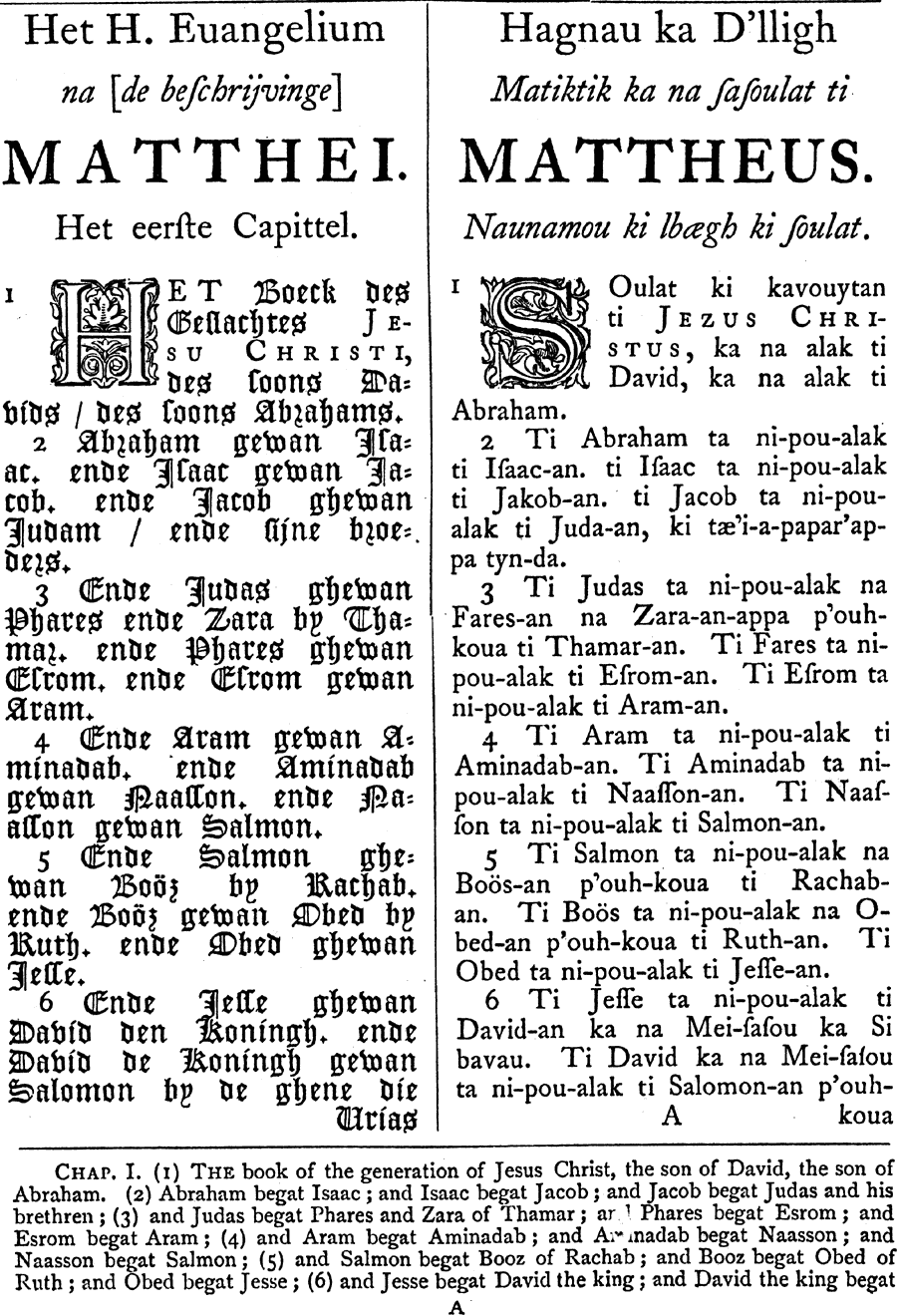
Pinyin News (“Most of what most people think they know about Chinese is wrong”) has a fascinating post on the centuries-old romanization of Taiwan’s aboriginal language Siraya (now extinct):

About 80 percent of the “Sinkang Manuscripts” (新港文書) have been deciphered in the ongoing collaboration project between Academia Sinica‘s Institute of Taiwan History and Institute of History and Philology. These documents, in the language of the Siraya people, were written in a romanization system devised by the Dutch colonists in Taiwan in the seventeenth century. Although the Dutch were forced out of Taiwan in the 1660s, writing in this system continued for at least 150 years.
The name Siraya, however, has been applied to the people of that group only since the period of Japanese rule (1895-1945). It was derived from the group’s pronunciation of the word for “I.” The documents get their name from Sinkang Sia, the largest Siraya settlement near the Dutch stronghold Fort Zeelandia.
Most of the documents are records of land contracts and business transactions. Some are bilingual: in Siraya and Dutch, or Siraya and Chinese. One long bilingual document is a translation by the Dutch of the Book of Matthew

THere are plenty of great links; check it out. (Via the always via-ble No-sword; as he says, “I wish the sample wasn’t one of the boring parts of the Bible, though. On the plus side I am now pretty confident that if a Siraya speaker ever asks me who begat someone, I will be able to answer in their native language.”)

GERMAN DIALECTS.

A nice link catalogue (maintained by the University of Exeter) of sites having to do with German dialects; the coverage (links in the right and left margins) is pretty amazing, with everything from maps to obscure Low Saxon dialects to related languages like Yiddish and Lëtzebuergesch (though Sorbian would seem to be pushing it, since it’s not even Germanic). Thanks, as so often, to aldi at Wordorigins.org.

Update (Oct. 2020). The site has moved, but happily still exists; I have updated the links.

ALGONQUIAN IN THE NEW WORLD.

A NY Times story by John Noble Wilford describes how linguists helped Terrence Malick get authentic Algonquian dialogue for his The New World (a wonderful movie, by the way, slow and gorgeous and moving):

When the director of “The New World,” Terrence Malick, decided that for authenticity Powhatan should speak in his own language, he called in Dr. [Blair A.] Rudes, who has worked with Dr. [Ives] Goddard in reconstructing the defunct Algonquian language of the Pequot of Connecticut. He is also engaged in language restoration for the Catawba of North Carolina and is collaborating with Helen Rountree, emeritus professor of anthropology at Old Dominion University, on a dictionary of Virginia Algonquian. Dr. Rudes was asked what Powhatan and his daughter Pocahontas would say and how they would say it. It was a daunting assignment.

The related Algonquian languages were among the first in America to die out, and no one is known to have spoken Virginia Algonquian since 1785. Like many other Indians, except some cultures in Mexico and Central America, Algonquian speakers had no writing system, and their grammar and most of their vocabulary were lost. Just two contemporary accounts — one by Captain Smith and the other by the Jamestown colony secretary, William Strachey — preserved some Virginia Algonquian words, including ones that have passed into modern English as raccoon, terrapin, moccasins and tomahawk…

The first challenge for Dr. Rudes was the limited vocabulary. Smith, the colony leader, set down just 50 Indian words, and Strachey compiled 600. The lists were written phonetically by Englishmen who were not expert in linguistics and whose spelling and pronunciation differed considerably from modern usage, making it difficult to determine the words’ actual Indian form.

Dr. Rudes had to apply techniques of historical linguistics to rebuilding a language from these sketchy, unreliable word lists. He compared Strachey’s recorded words with vocabularies of related Algonquian languages, especially those spoken from the Carolinas north into Canada that had survived longer and are thus better known. This family of Indian tongues, in one respect, reminded linguists of the Romance languages. Each was distinctive but as closely related as Spanish is to Italian or Italian to Romanian. Comparisons with related languages revealed the common elements of grammar and sentence structure and many similarities in vocabulary.

A translation of the Bible into the language once spoken by Massachusetts Indians offered more insights into the grammar. The Munsee Delaware version spoken by coastal Indians from Delaware to New York, including those who sold Manhattan, may be dead, but its grammar and vocabulary are fairly well known to scholars. “We have a big fat dictionary of Munsee Delaware,” said Dr. Rudes, who adapted some of those words when needed for Virginia Algonquian. Recordings of the last Munsee Delaware speakers, a century ago, were a valuable guide to pronunciations.

Another research tool was what is called Proto-Algonquian. It is the hypothetical ancestor common to all Algonquian speech, 4,000 words that scholars have compiled from the surviving tongues and documentation of the extinct ones. The reconstruction involves educated guesses. Strachey set down words for walnut, shoes and two kinds of beast, “paukauns,” “mawhcasuns,” “aroughcoune” and “opposum.” In Proto-Algonquian, similar words are paka-ni (meaning large nut), maxkesen (shoe), la-le-ckani (raccoon) and wa-pa’oemwi (white dog). From this, Dr. Rudes reconstructed the Virginia Algonquian words pakán, mahkusun, árehkan and wápahshum,” or pecan, moccasin, raccoon and opossum.

When he started the project, he was handed the movie script for the parts to be translated. “I had to rewrite terms for the dialogue,” he said. “For example, we often use nonspecific verbs, ‘He went to town.’ In Algonquian, you have to tell the mode of travel, ‘He walked to town.’ “

There’s a little idiocy (“Pocahontas would not have said to Smith, if she ever actually did, ‘I love you.’ She would have used the verb for love, with a prefix meaning you and a suffix for I.”), but hardly worth mentioning in a generally good and fascinating story; how can you not like a newspaper story that gives an entire line of dialogue in reconstructed Virginia Algonquian?

So Smith’s reply was changed to “We came from England, an island on the other side of the sea,” and the translator then used documented words of Virginia Algonquian for sky, no, island and sea. The spelling was slightly modified to account for Strachey’s misspellings and conform to similar words in other Algonquian speech. Because the word signifying a question is not known in Virginia Algonquian, Dr. Rudes borrowed the word sá from a related language.

Of course, Powhatan’s interpreter could not be expected to have a word for England. He presumably did his best to reproduce what it sounded like in Algonquian, Inkurent, to which he added the general locational ending -unk, meaning at or in. He also followed the practice of naming the place first and adding the word for “we come from there.”

The translation thus reads: “Sá arahqat? Mahta. Inkurent-unk kunowamun – mununag akamunk yapam.”

Now I’m even more eager to see the movie again. Thanks for the link, Bonnie!

BALASHON.

Balashon – Hebrew Language Detective is a new site that looks like it’s going to be a lot of fun. The blogger, who goes by DLC, says:

An American in Israel investigates language – modern and classic Hebrew, slang, Yiddish, Aramaic, Yeshivish, and more – with an eye on etymology. I’m not a professional linguist, and will be using this blog to explore my own questions, and I welcome yours as well.

The discussion is wide-ranging; the latest post is on besumei ‘intoxication’ and goes from the “obligation to get drunk on Purim” to the English word barmy (“while you might be feeling balmy while you are m’vusam – there might be a connection, but it’s not etymological”), and the earliest on the page at the moment is on teruma (which apparently means ‘donation’) and includes the following intriguing quote:

“אמרם בכל המשנה תרם ותורם ויתרום מקשים עליו הבלשנים החדשים, ואומרים שהעיקר הרים ומרים וירים. ואינו קשה באמת, כיון שהעיקר בכל לשון חוזר למה שדברו בו בעלי אותו הלשון ונשמע מהם, ואלו בלי ספק עבריים בארצם, כלומר בארץ ישראל, והנה נשמע מהם תרם וכל מה שהופעל ממנו. וזו ראיה שזה אפשרי בלשון, ושזה מונח מכלל המונחים העבריים. ועל זה הדרך תהיה תשובתך לכל מי שחושב מן החדשים שלשון המשנה אינו צח ושהם עשו פעלים שאינם נכונים באיזו מלה מן המילים. והיסוד הזה שאמרתי לך נכון מאוד אצל המלומדים השלמים המדברים על העניינים הכלליים הכוללים כל הלשונות כולם”.
To summarize, the Rambam is stating that linguistic innovation is legitimate, by saying that all languages change naturally by the people speaking them.

If anyone can provide an actual translation, I’d be grateful; I love such premodern acknowledgments of the process of language change.