The Linguistic Atlas of the World is a clever idea: each country is labeled with its name in its own language and writing system. I’ve already found one glitch (on the Asia map, Kazakhstan is labeled “Qazaq” rather than Qazaqstan, the official name being Qazaqstan Respublikasy), so I wouldn’t use it to settle bets, but it’s a lot of fun. (Via AskMetaFilter.)
ARABIC BY VIDEO GAME.
July 6, 2004 by 14 Comments
An article by Margaret Wertheim in today’s NY Times describes a program for teaching soldiers to speak Arabic by playing a video game:
In a dusty valley in southern Lebanon, “Sgt. John Smith” of the Special Forces scans the scene in front of him. Ahead is a village known as Talle. His immediate mission: to find out who the local headman is and make his way to that house.
All discussions with the villagers will have to be conducted in Arabic, and Sergeant Smith must comport himself with the utmost awareness of local customs so as not to arouse hostility. If successful, he will be paving the way for the rest of his unit to begin reconstruction work in the village.
Sergeant Smith is not a real soldier, but the leading character in a video game being developed at the University of Southern California’s School of Engineering as a tool for teaching soldiers to speak Arabic. Both the game’s environment and the characters who populate it have a high degree of realism, in an effort to simulate the kinds of situations troops will face in the Middle East.
It sounds like an excellent idea, and the article does a good job of describing the system (and some of the issues that come up: “Dr. Johnson noted that one of the first things many users have to learn is simply to say thank you. ‘Most video gamers are not used to saying thank you in the context of a game,’ he said”). But a couple of things struck me, one by its strangeness and the other by its [semi-]idiocy. The sentence after the introduction quoted above reads: “Talle is modeled on an actual Lebanese village, while the game’s characters are driven by artificial-intelligence software that enables them to behave autonomously and react realistically to Sergeant Smith.” A Lebanese village? As the article later says, “Arabic dialects differ considerably by region,” and the Arabic of Lebanon is very different from that of Iraq, which would presumably be of more use in the, um, current situation.
After describing the basics of the program, the article cautiously continues: “No one is going to be able to read Omar Khayyam after this training…” Now, I can’t be quite as scathing as I’d like to be, because Omar did, in fact, write many of his works on mathematics and physics in Arabic. But you know and I know that Ms Wertheim wasn’t thinking of those works, of whose existence I’ll bet a nickel she’s blissfully unaware. To the English-speaking world, Omar Khayyam is the author of the Rubaiyat, and those poems are written in Persian. So no, no one is going to be able to read Omar Khayyam after this training, no matter how good it is. [A commenter points out that Ms Wertheim has written books on mathematics and physics and thus is probably in fact aware, whether blissfully or not, that Omar wrote in Arabic. Fair point. But it’s still dumb to use his name in this context, because hardly anyone who reads the article will associate him with anything but the poetry. Hmph.]
SUDA/SUIDAS.
July 5, 2004 by 2 Comments
For as long as I’ve been interested in the classics (which is a very long time), I’ve been intrigued by the medieval compilation known traditionally as “Suidas” but more properly, apparently, as the Suda (which is apparently a Latin word for ‘fortress’); I kept seeing it quoted for bits of arcane information and points of grammar. Now I discover (thanks to the terrier-like industry of aldiboronti at Wordorigins) that it’s been online since January 1998, with more and more of its entries translated and annotated by its corps of volunteers. The About page says:
Although the Suda defies easy categorization it is without question one of the most remarkable extant of Byzantine Greek scholarship. The Suda was compiled probably in the latter half of the tenth century and certainly no later than 1000 CE, but its exact date is unknown, as is the identity of its compiler or compilers. Even the exact meaning of its title is obscure; it now seems most likely that suda is actually a Latin loan-word meaning “fortress,” a fitting title for a work whose purpose was to preserve and protect samples of ancient learning and literature. This was one of the primary goals of Byzantine scholarship in the tenth century; rather than creating new knowledge and areas of study, the scholars of that era labored to preserve the legacy of the past, and the Suda is one of the culminating achievements of “the encyclopedism of the tenth century.” Now, after yet another millennium has passed, we are revisiting the still-valuable work of these anonymous Byzantine scholars and preparing it for new media and new centuries of readers.
The Suda’s more than thirty thousand entries of names, terms, and phrases are arranged in simple alphabetical order, so that grammatical points and philosophical concepts intermingle with biographies of ancient authors and quotations from ancient texts. According to N. G. Wilson, the Suda represents a “significant stage in the evolution of this type of reference book,” since it “incorporates a mass of articles that are intended to be informative rather than lexicographical, and the result is a cross between a dictionary and an encyclopedia…”
CARL RAKOSI.
July 5, 2004 by 6 Comments
Seeing Michael Carlson’s Guardian obituary of Carl Rakosi, who died June 25, linked at wood s lot reminded me that I somehow let his passing go unremarked here, and I thought I’d remedy that now. The first paragraph of the obit situates him well:
Only one degree of separation links Carl Rakosi, who has died aged 100, with the poets of Victorian England, and that link is Ezra Pound. Rakosi made his mark in the Objectivist issue of Poetry magazine, in 1931, as a Pound protégé. But Rakosi and his fellow poets, George Oppen, Charles Reznikoff and Louis Zukofsky, were already moving past Pound’s modernism, which seemed to them almost as moribund as the tradition it was trying to overthrow.
(I note with sadness the omission of Lorine Niedecker among those names, where she certainly belongs; I am also surprised to learn that Rakosi legally changed his name to the less “ethnic-sounding” Callman Rawley after the publication of his first book in 1941, and the obit published in his home-town paper, the Star-Tribune, is titled “Callman Rawley, poet, dies”—if I’d opened up the paper and seen that, I’d have had no idea who they were talking about.)
One of my valued possessions is a copy of that 1941 Selected Poems (New Directions), from which I will quote a short poem, “To My First Born”:
I felt your foot below your mother’s breast
and said, “I am your provider,
let us get to know each other.
You have made me write a poem
and wake the neighbors with my shouting
until they cry, ‘What does he
think he is, the god of love’?”
(Incidentally, the last page of the book mentions, among other forthcoming publications, A New Group of Poems by John Berryman, Selected Passages from The Cantos of Ezra Pound, The Dry Season by Malcolm Cowley, A New Group of Poems by Dylan Thomas, An Anthology of Modern Mexican Poetry, Translations from the Russian of Boris Pasternak, Some Poems of Robert Herrick, A New Group of Poems by Robert Penn Warren, and Translations from Pushkin and Lermontov by Vladimir Nabokov. It’s easy to forget how important James Laughlin was to American culture.)
Shanna Compton, in her post “So long, Carl Rakosi,” quotes a longer poem, “A Journey Away,” which I highly recommend; the third part begins:
You were traveling through Delos
when the end came.On the esplanade at Cannes
the awnings suddenly
went black before me.
I was carried to the belvedere
of Villa Policastro.In the evening
in the sight of blood and bandages
I lay there like a dressed fowl…
Now, this being Languagehat, I’ll have to talk about his name, which is Hungarian in origin; the Hungarians spell it Rákosi and pronounce it RAH-koh-shee. (And that’s how I pronounce it to myself, since I don’t know how the poet said it; if any of my readers do, I beg them to let me know in the comments.) It’s an adjective derived from the name of the Rákospatak (Rákos Brook), which flows through Pest into the Danube and was formerly surrounded by open land. (My 1905 Baedeker’s Austria-Hungary says “The Hungarian diets from the 10th to the 14th cent. were held in the open air in the Rákosfeld, an extensive plain to the N. of the town, where 100,000 men are said frequently to have assembled on these occasions”; note the ambiguity introduced by the absurd attempt to avoid splitting the infinitive.) It is named for the crayfish (rák) that inhabited it; rák is a 14th-century borrowing from Slavic rak (of uncertain etymology), and both words also mean ‘cancer’ (from Latin cancer, whose primary meaning is ‘crab’).
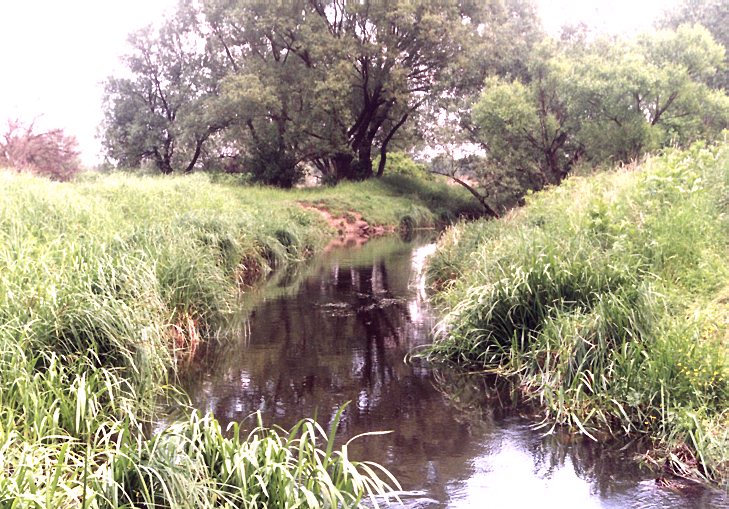
I’ll end, for no particular reason, with this quote from János Arany’s mid-19th-century epic poem Toldi: “Toward nightfall he saw the Castle of Buda, and before the sun sank he reached the famous and glorious fields of Rákos.”
MODERNIZING ARABIC.
July 4, 2004 by 1 Comment
Xavier of Buscaraons sent me a link to a brief but interesting post at kaleboel:
Cherif El-Shoubashy, first under-secretary for foreign cultural relations and president of the Cairo International Film Festival, has published a book called something like Long Live Arabic, Down With Sibawayh, Sibawayh being the Persian, Basra-trained linguist who, in al-Kitab, provided Arabic grammar with its tablets of stone. That was back in the eighth century, and El-Shoubashy’s point is that since the written language has changed considerably since then, since first millennium grammar is offputting to students, and since 81% of Muslims don’t speak Arabic anyway, it would be rational to contemplate reform.
I’m guessing the proposal is unlikely to go anywhere; at any rate, there’s more available (if you read Spanish) here.
FOOLSCAP.
July 4, 2004 by 16 Comments
A NY Times essay by John F. Burns (in today’s “Week in Review” section) includes the following sentence/paragraph:
Before the court, at that instant, 25 years almost to the week after he seized power in Baghdad, stood Saddam Hussein al-Majid al-Tikriti, the man who awarded himself titles of honor and glory to fill a foolscap page; the man who launched, or in some measure provoked, three disastrous wars; the man whose legacy runs to countless mass graves, and to hundreds of thousands of Iraqis killed, his very name synonymous, across much of the world, with a totalitarianism that turned the Iraqi state into a machinery of torture and death.
Now, that’s quite a parade of indignant rhetoric, but what caught my attention was foolscap and the phrase that contains it: “…who awarded himself titles of honor and glory to fill a foolscap page.” To me, this means unequivocally that he awarded himself those titles in order to fill up a literal foolscap page, a “long folio writing- or printing-paper” in the words of the OED, which seems improbable, on grounds of both motivation and culture (do they really use foolscap in Iraq?). I suppose you can make the assumption that he meant to write (or did write, and was betrayed by editorial or typographical gremlins) “enough titles… to fill a foolscap page,” but still, why foolscap? I can only conclude that Saddam’s record of war, butchery, and torture wasn’t enough for Burns, who felt he had to get a little dig in by implying the man was a fool to boot. I would remind him that a telling restraint is generally more powerful than scattershot (and purely etymological) insults.
SYLLABLES.
July 3, 2004 by 9 Comments
Des von Bladet has an interesting and (as always) amusing meditation on the nature of syllables and the counting thereof and what it all adds up to (“what have you accomplished that is distinguishable from not having accomplished anything?”). If the sentence “A word like ts’ktskwts’ ‘he arrived’ could be analyzed as having no syllables (since it has no vowels), or up to 5 or 6, depending on whether obstruents are considered syllabic and whether all consonants are analyzed as part of the syllable” makes your blood race faster, by all means go read the rest.
ETYMOLOGIE.
July 2, 2004 by Leave a Comment
Or, to give the site its full name, Etymologie, Étymologie, Etymology / __ Welt, World, Le Monde / Sprachen der Länder. It’s a collection of language links, with descriptions in German or English, followed by a (very incomplete) list of countries and their languages. I’m too bushed to investigate it much, having spent the day traipsing around Manhattan and the Met (last weekend of the Byzantine exhibition) with PF and a mutual friend (and much of the evening rooting on the Mets against the Yankees), but it looks worthwhile.
FROM BEE TO GAZETTE.
July 1, 2004 by 19 Comments
Tatyana, an always welcome contributor here at LH, has sent me a link to a very funny discussion (in Russian) of the decline of Russian newspaper names, from the lively variety of the early days (eg, Severnaya pchela ‘Northern Bee’) to the monotony of today’s News and Gazette (and of course the omnipresent Pravda ‘Truth’) in every town. The author, Olga Lukas, compares this to a class she was in once with three Olyas (besides herself) and two Smirnovs, in which the poor physics teacher would say “Smirnov to the blackboard — no, not that one, not Masha but Olya — not that Olya, dammit, not Kuznetsova, the other one…” There was also a girl with the unique name of Nurlana, admired for her unordinariness. “It would be better if there were more Nurlanas among newspapers, and fewer Olyas.” And there’s a great riff on a drunk locating himself by his town paper that I’m not even going to try to reproduce. [Jan. 2023: Oh, I might as well add it here: Чтобы всякий пьяный человек, взявший с пола эту бумажку, понял и оценил: “Я нахожусь в Месте, в руках держу Газету. Как интеллигент! Пойду еще тяпну!”]
KING GUBU.
July 1, 2004 by 2 Comments
In a sort of raucous melange of my recent posts Braw and witty (the Scotticizing of Aristophanes) and Patapoufs! Anthropophages! (the comic use of French puns and insults), I bring you King Gubu, the Irishization by Tom Quinn of Alfred Jarry’s scandalous 1896 play Ubu Roi, whose famous opening exclamation “Merdre!” and the following lines are rendered:
Mister Gubu – Gobshites!
Missus Gubu – Oh, would you ever whist with yur Gubu-ulations, Mister Gubu, ya big eejit ya!
Mister Gubu – Ooh! Ooh! Careful now! Don’t have me to do ya in now, Missus Gubu!
Missus Gubu – It isn’t me ya should be doin’ in, Mister Gubu, it’s another fellow altogether.
Mister Gubu – Green shite, m’dam, I don’t understand a word yur saying.
Braw and witty stuff, to be sure! (Via wood s lot.)
Recent Comments