Avva directed me to this site, which reproduces the 1922 Petrograd Berlin [thanks, Anatoly!] edition of Osip Mandelshtam‘s Tristia; scroll down past a couple of introductions for jpg files of each page with transliterations and (shaky) literal translations of each poem, as well as notes on both text and content. It’s a wonderful resource…
BILINGUAL MANDELSHTAM.
April 28, 2003 by 8 Comments
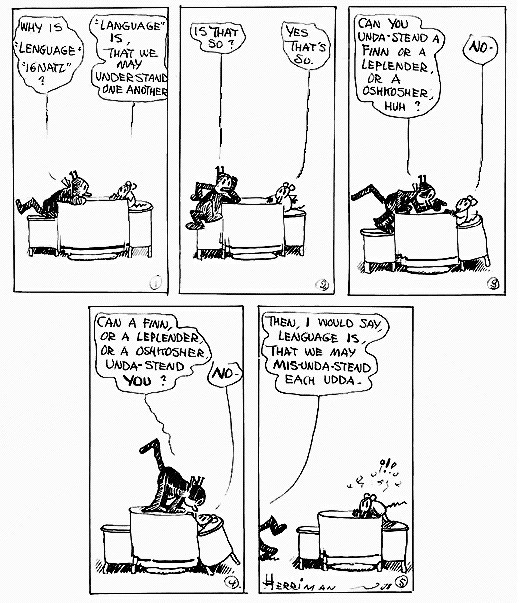
WHY IS “LENGUAGE” “IGNATZ”?
April 28, 2003 by 6 Comments
“Language” is, that we may understand one another. Is that so? The brilliant George Harriman, courtesy of the tireless y2karl (via MetaFilter).


Update. A link that works as of March 2014 (thanks, Anton!).
AMERICAN HERITAGE: USAGE.
April 27, 2003 by 1 Comment
For some time, prodded by the unending debates I get into about English usage, I have contemplated writing a long entry in which I would set out the arguments on either side and steer a reasonable course between the extremes, giving such convincing examples that readers would understand at last, and hopefully even stop whining about “hopefully” (and “disinterested” and “hoi polloi” and all the rest of the shibboleths). Thinking about this tired me out, and I would read a good book instead. Now, as so often happens, procrastination has paid off, and I no longer have to do the oft-postponed task.
This is because I’ve finally gotten a copy of The American Heritage Dictionary of the English Language, Fourth Edition (online for free, but I always prefer physical books, and this one is beautifully produced), and discovered the brilliant essay on usage by Geoffrey Nunberg. Nunberg, whom I have recommended before, is a linguist who understands the prescriptivist arguments and even accepts some of them (at times I had to swallow hard while reading, but I never rebelled); his ideas are sensible, probably more so than mine would have been, and should convince all but the most closed-minded. The first three paragraphs should give an idea of what he’s up to:
Viewed in retrospect, controversies over usage usually seem incomprehensibly trivial. It is hard for us to fathom why Swift should have railed against the shortening of mobile vulgus to mob, why Benjamin Franklin should have written to Noah Webster complaining about the use of improve to mean “ameliorate,” or why Victorian grammarians should have engaged in acrimonious exchanges over whether the possessive of one should be one’s or his. Even comparatively recent controversies have a quaint air about them: most people under 50 would be hard-put to understand what in the world critics of the 1960s had in mind when they described the verb contact as an “abomination” and a “lubricious barbarism.”
This does not necessarily mean that there was never any substance to these controversies—or that there is nothing of importance at stake in the issues that modern critics worry over, even if it is certain that most of them will strike our successors as no less trivial than Swift’s and Franklin’s complaints seem to us. In his time, Swift may have been within his rights to complain about mob, which began as an affectation of aristocratic swells. The fact that the word later settled into middle-aged respectability doesn’t retroactively excuse its youthful flippancy. And contact started as business jargon before it was generally adopted as a useful verb. Perhaps current jargon like incentivize will develop along the same lines, but it doesn’t follow that critics have no justification for objecting to it now.
Past controversies should put us on our guard against viewing these disputes too narrowly. Disputes about usage are always proxy wars. What is important is not the particular words and expressions that critics seize on at a given moment but the underlying mental vices that they (often temporarily) exemplify—for example, foppery, pretension, or foggy thinking. Language criticism is instructive only when it takes words as its occasion rather than as its object.
I’ll add that I’ve loved the AHD since its very first edition, which came out while I was in college and just discovering Indo-European; not only did this dictionary have illustrations in the margins and helpful (if sometimes prissy) Usage Notes, it had an appendix listing all IE roots that gave rise to English words. (I still have my much-annotated original copy of that appendix.) The Fourth Edition has gorgeous color illustrations, much less prissy Usage Notes, and a Semitic appendix to go along with the IE one. (Did you know that Hebrew magen ‘shield,’ as in “
HOW TO BOW.
April 27, 2003 by 6 Comments
This remarkable flash presentation not only teaches you how to bow correctly, it takes you through the entire complicated ritual of visiting a Japanese company, being introduced, presenting business cards, &c., accompanied by appropriate spoken dialog (with subtitles) and sidebars containing all sorts of relevant information (for instance, you should never write with red ink, since it was used for death sentences in ancient China and is considered highly inauspicious). Via plep.
SPOFFISH.
April 26, 2003 by 4 Comments
The Discouraging Word today explores the brief history (three recorded occurrences) and hard-to-pin-down meaning of a word that must have been in fleeting vogue in the fourth decade of the nineteenth century. You might also want to scroll down (none of your newfangled permalinks for TDW!) to the April 21 entry “Wonky pillars, and why the OED no longer considers us polite” for an exegesis of the more current, if not exactly familiar (to Yanks), word “wonky.”
Update (Sept. 2020). The OED still hasn’t updated its entry for spoffish; I might as well copy the last part of The Discouraging Word’s post to save the clickthrough (the site is dead, so it doesn’t need the traffic) if people just want the conclusion:
Understandably, neither M-W nor American Heritage are of any help. Thus we have resorted to a(nother) Google search, which turns up a few semi-valuable items: the folks at Chambers, for example, having deemed it one of Our Favourite Words, simply repeat the OED with their “fussy, officious (archaic).” A 1913 edition of Webster’s unabridged dictionary, however, is much more useful. Consider its definition:
a. [probably from Prov. E. spoffle to be spoffish.] Earnest and active in matters of no moment; bustling. [Colloq. Eng.] Dickens.
That far better captures the delicious irony that Dickens employs in his description of Noakes and throughout Sketches more generally. The “fussy” and “officious” of the OED’s definition foreclose the meaning of the word: while we don’t think spoffish could be a compliment, Dickens surely isn’t using it as an outright insult for Noakes, as the OED would suggest. Webster’s instead captures Dickens’ nuance quite adroitly. And it should be praised for hazarding an etymology, however unsupportable it may be.
(Spoffle, by the way, is not in the OED, although some have tried to neologize the word by applying it to “the large, sausage-like expanded foam device used by sound-men to cover their microphones.” That sense — or a related one — has achieved circulation in a picking-apart of the film Urban Legend, at least. And here. The word also seems to crop up on a number of seamy sites which we shall allow you, faithful readers, to pursue on your own.)
All in all, then, we recommend that future editors of Sketches use Webster’s definition, not the OED’s. For a word that seems largely Dickens’ own, the OED should have been more attentive to its original context.
THE EVOLUTION OF ARABIC WRITING.
April 26, 2003 by 25 Comments
Mamoun Sakkal has an excellent short history of Arabic writing and calligraphy. (Via Eclogues.)
Addendum. Directly below the Arabic link at Eclogues is one to The New and complete manual of Maori conversation : containing phrases and dialogues on a variety of useful and interesting topics : together with a few general rules of grammar : and a comprehensive vocabulary (Wellington, N.Z.: Lyon and Blair, Printers, Lambton Quay, MDCCCLXXXV, Rights Reserved). Sample exchanges:
THE PLURAL OF CHEVAL.
April 26, 2003 by 5 Comments
La grande rousse [archived] emphasizes for the benefit of lazy pluralizers that there is no such word as “chevals“; in so doing, she links to an interesting brief entry at the Banque de dépannage linguistique of the Office québécois de la langue française, which in the course of explaining why the word is chevaux clears up a detail I had never thought to wonder about, namely why -x is used for plurals in the first place. It seems that the ending -us resulting from the pre-French change of /l/ to /u/ before another consonant was written by scribes with an abbreviation that looked like an “x”; later scribes, thinking it was in fact an “x,” wrote it that way, so that what had been “chevaus” now read “chevax.” Still later copyists thought a “u” had been omitted and inserted it, producing “chevaux,” which became established—just one of the bits of weirdness that make the French one of the few peoples on earth who cannot plausibly make fun of English spelling.
THE KING’S WORDS.
April 25, 2003 by 1 Comment
Yemsa is a minor language of Ethiopia, the language of the former kingdom of the people who call themselves Yamma and were absorbed into Ethiopia in 1894; people, kingdom, and language are traditionally called Janjero or Zenjaro, an insulting Amharic term meaning ‘baboon.’ A book by G.W.B. Huntingford, The Galla of Ethiopia: The Kingdoms of Kafa and Janjero, contains the following description (quoted in Andrew Dalby’s Dictionary of Languages, p. 475) of a remarkable feature of the language:
SAPIR-WHORF.
April 25, 2003 by 4 Comments
In an earlier entry I referred to the Sapir-Whorf hypothesis, which says that the way we see and think about the world is influenced (in the moderate version) or determined (in the strong version) by the language we speak. A short article by Daniel Chandler summarizes thus:
Whilst few linguists would accept the Sapir-Whorf hypothesis in its ‘strong’, extreme or deterministic form, many now accept a ‘weak’, more moderate, or limited Whorfianism, namely that the ways in which we see the world may be influenced by the kind of language we use. Moderate Whorfianism differs from extreme Whorfianism in these ways:
* the emphasis is on the potential for thinking to be ‘influenced’ rather than unavoidably ‘determined’ by language;
* it is a two-way process, so that ‘the kind of language we use’ is also influenced by ‘the way we see the world’;
* any influence is ascribed not to ‘Language’ as such or to one language compared with another, but to the use within a language of one variety rather than another (typically a sociolect – the language used primarily by members of a particular social group);
* emphasis is given to the social context of language use rather than to purely linguistic considerations, such as the social pressure in particular contexts to use language in one way rather than another.
(Other discussions here and here, here is a collection of old LinguistList posts on the topic [1991-99], and Stavros has a recent entry discussing it in relation to Korean hierarchical forms of language.)
I have no new insights to offer regarding the hypothesis itself (though I will say that the Chomsky-Pinker outright dismissal of it is based on their assumption of the underlying identity of all languages, which I consider absurd.) I would, however, like to mention an experiment I carried out in my college years, when I was too ignorant to realize I had neither the experience nor the resources to do a good job of it. I copied a number of illustrations of simple scenes, simple enough that there were only a few elements to describe (a woman getting water from a well, a man going through a door, that kind of thing). I then showed the series to native speakers of as many different languages as I could find on my (fortunately very diverse) campus and asked them to write one-sentence descriptions in their native languages. My hope was to show skewing of description that would correlate with the grammatical structures of their languages; as I recall, the results were suggestive but not conclusive (and how could they have been, given that I was wet behind the ears and stumbling around in the dark?). But it seems to me that a similar experiment, done by people who knew what they were doing, could provide some valuable insight, more valuable than the simple asseverations that pass for argument at present. If anyone knows of work along those lines, please let me know. And if anybody thinks I’m talking through my hat, they’re probably right. All comments are welcome.
THE LANGUAGES OF FINLAND.
April 24, 2003 by 6 Comments
Rara Avis illustrates an entry on the former hierarchy of languages in Finland with this photo of a trilingual street sign, which reminds me of my only visit to Helsinki, back in 1971. At that time nobody in the city seemed to speak English, and I spoke no Finnish or Swedish, so the only common language available was Russian—except that nobody in Finland wanted to speak Russian (except for the aged caretaker of the Russian Orthodox cathedral), so I was effectively cut off from verbal communication. A very strange experience. (When I say I spoke no Finnish, by the way, I exaggerate slightly. I had painstakingly taught myself one Finnish sentence, which still rolls easily off my tongue over 30 years later: Puhutteko englantilainen englantia? Do you speak English? [Thanks for the correction, Dmitri!] Alas, the response to my fluently produced query was invariably a flood of incomprehensible Finnish. Belatedly, it dawned on me that the only useful sentence in that context is “Do you speak English?” In English. Live and learn.)
In an entry today, incidentally, Rara refers to the Academic Bookstore, which is apparently the Foyles of Helsinki; I suspect it’s the huge bookstore where I found all the Russian books I’d been unable to find in Russia itself (these were the days when the only books available in Soviet bookstores were the complete works of Lenin and whatever books had just been published that week—unless they were of any interest, in which case they had vanished within minutes). Thanks for the trip down memory lane, Rara!
Update (Mar. 2021). I’ve gotten spoiled by the Wayback Machine; I feel bitter and resentful that they didn’t capture any Rara Avis links from this incarnation (though they do faithfully preserve the one trial post from a later blog at the same URL). Needless to say, the links in the post are dead. Bah.
Recent Comments