Yes, Which Indo-European Subfamily Are You? is just another dumb Buzzfeed quiz, but obviously it’s not one I could resist. You get eight or so silly questions and then it tells you your subfamily. The first time I got Germanic; the second, picking different answers for everything, Armenian (“Exasperation of aspiration, sensitive to satemization. Only God can judge you but that doesn’t stop every philologist from trying”). Enjoy!
Tolstoy’s Children’s Stories.
May 9, 2020 by 74 Comments
John Byron Kuhner’s Leo Tolstoy’s Children’s Stories Will Devastate Your Children and Make You Want to Die begins:
The Russian novelist Leo Tolstoy, also a gentleman farmer, operated an ancestral estate called Yasnaya Polyana that included a small school for the children of the peasants who labored there. Tolstoy was known to drop by from time to time and share stories that he wrote himself, which, in his typical modesty, he predicted would be read by “thousands, even millions.”
In 1988, the children’s novelist and Russia expert James Riordan translated several of these for a collection called The Lion and the Puppy: And Other Stories for Children, published first by Henry Holt and Company. The cover has a nice picture of a lion and a puppy; the illustrations by Claus Sievert are lovely throughout. My children fell in love with that picture, and they wanted me to read them the book. My first thought was: Children’s stories by the author of the inspirational The Death of Ivan Ilyich? But pestilence has closed the schools and home reading was important. Tolstoy wrote them; they couldn’t be that bad. Now I sincerely wish I had never touched them.
The first story turned out to be the only one we endured together. It’s about a hungry lion in the zoo, whose keepers comb the streets for stray cats and dogs to feed him. Tolstoy recounts the lion coming for a puppy that got lost by its master: “Poor little dog. Tail between its legs, it squeezed itself into the corner of the cage as the lion came closer and closer.”
The lion decides not to eat this puppy, and they become friends. Until we get to page two, when the puppy, now a year old, suddenly sickens and dies. So what does the lion do? “[H]e put his paws about his cold little friend and lay grieving for a full five days. And on the sixth day the lion died.” The end.
“Daddy,” my stunned four-year-old son asked, “why did the lion die?”
“Daddy Daddy,” my daughter asked, still wondering about the now-dead lion’s lifestyle, “why did the people feed the lion puppies?”
So I took the book away and hid it from the children. Later I read it through. If you do this, be sure to read something lighter afterward, like perhaps Anna Karenina’s suicide scene, or a biography of Sylvia Plath. The rest of the stories are just as dark as the first one.
He goes on to describe a bunch more, e.g.:
“The Little Bird.” A boy catches a bird in a cage. His mother says he shouldn’t do that. He leaves the door of the cage open. The bird flies out, straight into a glass window, knocking itself out. It suffers for a few days, then dies. The end.
It’s very funny, and ends with a warning about the most recent edition, whose publicists say things like “children will be able to take away important lessons, as well as laugh at silly mishaps and characters, from this timeless collection” and “sure to captivate and delight children of all ages.” Kuhner pleads: “Do not give this book to children. Anything is better than this. Jude the Obscure. Maybe some Elie Wiesel. Spengler.” (As counterpoint, a commenter says “I remember absolutely loving these stories as a fifth-grader — so much so that I tried to convince my teacher to read them to our class!”)
A Frustrating Article.
May 8, 2020 by 75 Comments
Kelly Grovier at BBC Culture writes a piece that perfectly illustrates the pitfalls of the popular belief that earliest attestation is the same thing as word creation. HerHis thesis is that “it was often female writers who sculpted the fresh coinages that kept language rippling with poignancy and power.” She He illustrates it by combing the OED for citations by women; her his first example is:
The word ‘frustrating’ itself, according to the Oxford English Dictionary, makes its first appearance in print in George Eliot’s novel Middlemarch, where she presciently describes “the hampering threadlike pressure of small social conditions, and their frustrating complexity”.
SheHe doesn’t even bother to provide the date of the novel, 1872; alas, it’s trivially easy to antedate the usage to 1841 with a quick glance at Google Books (Catherine Grace Frances Gore, Greville; Or, a Season in Paris, p. 9: “He was master of himself and his yacht; and dearly as he loved his mother, it was something to feel freed from a frustrating influence”), and I’m sure a little more effort would push it back farther. SheHe lists a number of “rules”; I’ll quote the first in extenso to show the general nonsense involved:
Rule no 1: Get your ‘-ness’ on
The suffix ‘-ness’ can transform an otherwise unremarkable word into something stranger and more affectingly abstract. The adjective ‘dark’, for example, on its face is frank and factual, whereas ‘darkness’ is more movingly evocative and poetic. Dorothy Wordsworth understood that linguistic trick profoundly and exploited it to memorable effect when describing an uncanny walk she took with her brother, William, in Scotland in 1803 […]. The soulful scene, Wordsworth said, magically contained “that visionariness which results from a communion with the unworldliness of nature”. It was the first time, according to the OED, that the words ‘visionariness’ and ‘unworldliness’ are known to have been used. Today, unnerving-nesses stack up around us: the unvisitedness of our parents and grandparents. The unembracedness of our friends. The egglessness of our pantries.
“The adjective ‘dark’, for example, on its face is frank and factual, whereas ‘darkness’ is more movingly evocative and poetic”: WTF?! As for the particular words, “visionariness” is a random example of an adjective with -ness stuck on, such as can be formed at any time by anybody, and “unworldliness” is just as easily antedated as “frustrating” (1732: J. Morgan, Phœnix Britannicus, p. 22, “the Unworldliness of Mind”). Rule no 2 is “To demonstrate the profound depths of one’s connection with a place or feeling, simply fastening an ‘-r’ or an ‘-er’ to the end of a noun can confer a new existential title” (“it was Jane Austen who, in a letter she wrote in 1800, seized upon the alienness of a group of random gamblers who had gathered around a casino table, none belonging to the place itself and all having come from an undefined ‘outside’, to christen all such future strangers as ‘outsiders’”); Rule no. 3: “Join the Hyphen Nation” (“Charlotte Brontë was a genius of such curiously compelling compounds. To her it is likely we owe the origin of ‘self-doubt’ and ‘Wild-West’ as well as that activity to which many of us have found ourselves suddenly engaging with obsessive vigour: ‘spring-clean’, which Brontë niftily neologised in a letter she wrote in April 1848”); and Rule no. 4: “The Wisdoms of ‘-isms’” (“The novelist George Eliot […] is also credited with formulating, in a letter she wrote in 1885, something rather less negative in its outlook and attitude: the term ‘meliorism’, or the belief that the world’s suffering is healable if we all work together for that end”). Surely the blithering idiocy of all this is evident on its face; I make the charitable assumption that there was a pressing deadline involved, and perhaps a few glasses of wine, but still it’s depressing to think that this sort of drivel can be published in the year 2020 — I thought we’d come at least a bit farther. (Thanks, AJP!)
Update. My thanks to Conrad H. Roth for setting me straight on the gender of the blithering idiot.
Bely’s Second Symphony.
May 7, 2020 by 10 Comments
I’ve long been intrigued by Andrei Bely’s first published prose works, his set of four “symphonies,” and since everyone seems to agree that the first to be published [in 1902], Симфония (2-я, драматическая) [Symphony: Second, Dramatic], is without question the best of them and perhaps the only one really worth spending time on, I bought a copy of it. Unfortunately the edition I got is crappy (print-on-demand, shoddily bound and produced, horrible cover, doesn’t reproduce Bely’s numbered lines and line breaks), but hey, it was cheap and gives me something to make notes in, and thanks to the amazing Bely Memorial Apartment Site with its online versions of all editions of his work published in his lifetime, I am able to consult the first edition whenever I want.
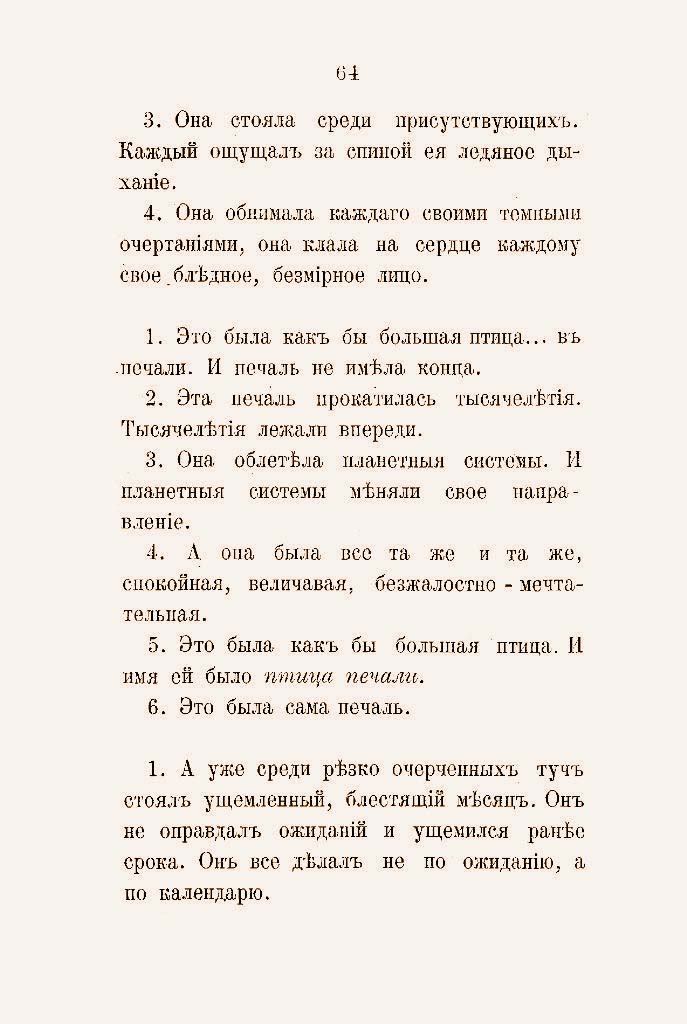
But before I get to the symphony, I’ll say something about Bely in general. He’s been called the most difficult of Russian writers, and while once I would have scoffed at that, I’m now inclined to believe it. There are writers with weirder vocabulary (Remizov), more opaque style (Platonov), general craziness (Khlebnikov), and so on, but nobody combines so many forms of difficulty as Bely. He doesn’t use as many strange words as Remizov, but some of them are impossible to interpret even for Russians (a good example is безмирный, which he used repeatedly; there’s a whole WordReference.com forum discussion of what he might have meant by it, somewhat vitiated by the fact that nobody bothers to check the old spelling — it’s written with і, not и, as you can see in the sixth line of p. 64, so it can’t possibly mean ‘without peace’). His style is so musical it’s easy to be seduced by the sound into not bothering to figure out what’s going on or what he’s trying to say. He alludes to so many people, ideas, and phenomena of the period that to really get it you’d have to do a separate study (and there is an excellent book that allows you to do just that — see my review). And, perhaps most importantly, he was obsessed throughout his life with a mix of philosophy and mysticism that lurks behind everything he wrote and is essential to interpreting it in a way he would have approved of (though not to enjoying it, which you can do in all sorts of ways). Here’s a quote from the Introduction to J. D. Elsworth, Andrey Bely: A Critical Study of the Novels
[Read more…]
Misused Terms in Linguistics.
May 6, 2020 by 89 Comments
Evelina Leivada, a psycholinguist at the Universitat Rovira i Virgili in Tarragona, has an article in Inference, Misused Terms in Linguistics, that begins:
The evolutionary biologist Eörs Szathmáry observed that linguists “would rather share each other’s toothbrush than each other’s terminology.” This is far from an isolated view. Peter Hagoort, an eminent cognitive neuroscientist, voiced similar concerns. […] Tanja Kupisch and Jason Rothman, psycholinguists working primarily on bilingual development, recently noted that “[o]nce offered to the public domain, terminology can have far-reaching and long-lasting effects, even—perhaps especially—when these are unintended by their original promoters.”
An effort to improve the terminological clarity and coherence of theoretical and experimental linguistics is long overdue. In this respect, linguists might consider following the lead of psychologists in identifying and discussing lists of inaccurate, ambiguous, misused, and polysemous terms. The focus throughout should be on key notions of the field. Terms such as feature, parameter, (grammaticality/acceptability) judgment, (language) universal, and Universal Grammar are omnipresent in linguistics. These notions are fundamental to the discipline and their misuse has important implications, not only for the coherence of the field, but also for its standing in the broader context of cognitive science. The following terms do not all satisfy the same criteria of inaccuracy, ambiguity, and misuse. The degrees to which they exhibit these characteristics vary, and this is part of the problem. This review will not focus solely on the conceptual clarity of these ten terms, but also on their inconsistent usage.
I’m so far removed from the kind of linguistics that depends on such terms that I find much of it hard to understand, but it will probably be of interest to some Hatters, and I am amused by her attempts to salvage a system in which she is apparently invested:
The identification of FLN and UG is wrong. If UG equals FLN, and if FLN is, indeed, an empty set—a possibility that Chomsky has once again left open in his latest book with Robert Berwick—scholars outside generative linguistics would inevitably question the need to assume a UG-shaped form of innateness. Furthermore, if UG and FLN are indeed the same, why are two terms needed to denote one object?
But, of course, FLN is not the same thing as UG. […]
Of course not! Perish the thought!
Some Links.
May 5, 2020 by 125 Comments
A few tidbits of interest:
1) Via Laudator Temporis Acti, W.S. Merwin describes a visit to Ezra Pound at St. Elizabeth’s:
He told me he imagined I was serious, and that if I was I should learn languages, “so as not to be at the mercy of translators.” And then I should translate, myself. “If you’re going to be a poet,” he said, “you have to work at it every day. You should write about seventy-five lines a day. But at your age you don’t have anything to write about. You may think you do, but you don’t. So get to work translating. The Provençal is the real source. The poets are closest to music. They hear it. They write to it. Try to learn the Provençal, at least some of it, if you can. Meanwhile, the others. Spanish is all right. The Romancero is what you want there. Get as close to the original as you can. It will make you use your English and find out what you can do with it.”
2) Paul Goble, Coronavirus has Radically Affected the Language Russians Speak, Basovskaya Says:
One measure of the seriousness of any development is how deeply it affects not only the behavior of the people but also the language they use to describe what is going on. By that measure, Yevgeny Basovskaya says, the coronavirus pandemic, which has had a “radical” impact on the language Russians speak, is an especially serious one.
The specialist on public speech at Moscow’s State University of the Humanities says that the impact begins with the word coronavirus, which includes the letter “a” in the middle of it in complete violation of Russian orthographic rules. It should by rights be an “o” but it isn’t and so feels alien for that reason alone […]
Then, there is the increasingly widespread use of the word pandemic. “Even the uneducated recognize this word,” but to recognize it is not to understand it. Basovskaya recalls than in 2008, people on the street told her that default meant there were no matches in the stores. Now, many Russians probably think that pandemic means there is no buckwheat.
The word “distancing” (udalyonka), of course, has been formed according to the same rules that lead Russians to speak about elektrichka for a local train or
sotisalka[sotsialka] for public benefits. But it has also been given a popular connotation that puts it at a distance from government orders for “self-isolation” (samoizolyatsiya), a truly bureaucratic term.
“Radically” is silly, of course, but there are some interesting examples.
3) Jonah Mandel, Letter shows first dictionary editor thought ‘anti-Semite’ wouldn’t be used:
A short-lived term unlikely to have use in the future: that was how the first editor of the Oxford English Dictionary viewed “anti-Semite,” recently uncovered archival documents show. Celebrated British lexicographer James Murray, who with his team began working on the first OED in 1879, planned several dedicated entries of words beginning with the prefix “anti.” But when a prominent member of Britain’s Jewish community, Claude Montefiore, learnt that “anti-Semite” and its derivative terms would not have an entry, he wrote to Murray expressing concern.
Murray replied to Montefiore on July 5, 1900, as the original OED was being published in installments — a process that ran from 1884 to 1928. In Murray’s letter — recently uncovered by Israel National Library archivist Rachel Misrati — he noted that the term anti-Semite had only migrated from German to English in 1881 and did not look likely to take hold given its limited usefulness. […] “Hence they did not receive treatment in a separate article,” he added, arguing in the letter’s postscript that “the man in the street would have said Anti-Jewish.” […]
Murray’s letter reveals his evolution in thinking and said that by 1900 he had doubts that leaving anti-Semite out of the OED was the right decision. “Would that anti-Semitism had had no more than a fleeting interest!” he wrote. […] “It is unutterably saddening to one like myself who remembers ’48 and the high hopes we had in the fifties.”
“Probably if we had to do that post now, we should have to make Anti-Semite a main word,” Murray wrote.
(Thanks, Alon!)
4) Jay Serafino, The Russian Family That Cut Itself Off From Civilization for More Than 40 Years: “The Lykov family left Russian society under persecution in the 1930s and remained hidden until 1978.” A fascinating tale of Old Believers hiding out from persecution. (Thanks, jack!)
How to Understand Aliens.
May 4, 2020 by 68 Comments
Last night, having just watched a documentary on the Connecticut River flood of 1936, my wife and I discovered that our basement had flooded — apparently the sump pump had failed. So this morning we called the Barstows (it’s great to have contractors you can rely on in emergencies) and they sent a crew over within half an hour, unclogged the pump (“you should have it checked every year”), vacuumed the floor, and left. I investigated and discovered that, although most of the boxes were up out of harm’s way (a precaution we took after the last flood, a decade or so ago), there was a box of sf books and magazines that had gotten wet, so I brought it up, opened it, and set everything out to dry. Part of the contents was a set of Worlds of Tomorrow, a companion magazine to If which I was buying in the mid-’60s; I opened the January 1966 issue at random and found in the table of contents “How to Understand Aliens,” by Robert M. W. Dixon. “The Robert M. W. Dixon?” I thought, and sure enough, the Australianist linguist about whom I posted repeatedly in January 2006 (1, 2, 3, 4, 5, 6) had written both stories and articles for sf magazines back in those days.
I wish I could send you to an online version of “How to Understand Aliens,” but there doesn’t seem to be one. You can see the beginning in accursed snippet view here, but that’s not much help. You can read the article here (thanks, Owlmirror!). I’ll copy out a short passage that will give you some idea; the whole thing is well done, as one would expect, and hopefully gave some readers (and writers) a better idea of how language works:
Space linguists could gain valuable practice in unravelling bizarre languages by having a preliminary workout on a terrestrial language before venturing into extra-terrestrial contact. For instance, a cadet linguist thrown amongst a tribe of Australian Aborigines would be able to get an idea of the variety of similar meanings a word can have when he learned that gargal could mean, firstly, the upper part of the human arm as it meets the body; secondly, the lower part of a branch, where it meets the trunk of a tree; and thirdly, the mouth of a stream where it flows into a larger river. And of how the meaning of a word can be extended to apply to new situations: the word for ‘hollow log’, maralu, being taken over to apply to ‘shirt’ when the aborigines first came into contact with white men wearing this novel garment.
Hobo Jake and a Counterfactual Universe.
May 3, 2020 by 211 Comments
Philip Jenkins’ Jesus Wars: How Four Patriarchs, Three Queens, and Two Emperors Decided What Christians Would Believe for the Next 1,500 Years
Looking back at its long history, Egypt’s Christians only knew state favor for a fleeting interval, and a similar story could be told of Syria, that other ancient center of the faith. From 542 to 578, the greatest leader of the Monophysite church was Jacobus Baradaeus, whose nickname refers to the rags he wore to escape the attention of imperial authorities constantly on the watch for this notorious dissident. Translating his name as “Hobo Jake” would not be far off the mark. Instead of living in a bishop’s palace, he remained ever on the move, wandering from city to city. He roamed between Egypt and Persia, ordaining bishops and priests for the swelling underground church. His career, in other words, looked far more like that of an early apostle than a medieval prelate, and there were many others like him. Numerically, Jake won far more converts than Paul of Tarsus, and he covered more ground. The heart of the Christian church never left the catacombs, or if it did, it was not for long.
[…]
We can imagine a counterfactual universe in which the schism between Rome and the East occurred in the fifth century, not the eleventh, and papal Rome never recovered from subjection to successive waves of barbarian occupiers. By 450, much of the old Western empire was under the political control of barbarian warlords who were overwhelmingly Arian Christians, rather than Catholics. Perhaps the papacy might have survived in the face of Arian persecution and cultural pressure, perhaps not. In the East, meanwhile, the Monophysite Roman Empire would have held on to its rock-solid foundations in a faithfully united Eastern realm that stretched from Egypt to the Caucasus, from Syria to the Balkans. This solid Christendom would have struggled mightily against Muslim newcomers, and conceivably, they would have held the frontiers.
Later Christian scholars would know the fundamental languages of the faith — Greek, Coptic, and Syriac — and they would have free access to the vast treasures surviving in each of those tongues. Latin works, however, would be available only to a handful of daring researchers willing to explore that marginal language with its puzzling alphabet. Only those bold Latinists would recall such marginal figures of Christian antiquity as Saints Augustine and Patrick. In contrast, every educated person would know those champions of the mainstream Christian story, Severus of Antioch and Egypt’s Aba Shenoute. In this alternate world, the decisive turning point in church history would have been not Chalcedon, but Second Ephesus, which we today remember as the Gangster Synod, the Council That Never Was. And the One Nature would have triumphed over the noxious errors of the Dyophysites, the Two Nature heretics.
I know some historians look down their noses at alternate history, but I love it, and I find this example particularly stimulating. Down with Latin, up with Greek, Coptic, and Syriac! Long live Severus and Aba Shenoute!
At Home in the Russian Kasbah.
May 2, 2020 by 47 Comments
I’m finally getting around to reading a book that a kind Hatter got me almost a decade ago (thanks, Andrei!), Stalin’s Children: Three Generations of Love, War, and Survival
I spoke Russian before I spoke English. Until I was sent to an English prep school, dressed up in a cap, blazer and shorts, I saw the world in Russian. If languages have a colour, Russian was the hot pink of my mother’s seventies dresses, the warm red of an old Uzbek teapot she had brought with her from Moscow, the kitschy black and gold of the painted Russian wooden spoons which hung on the wall in the kitchen. English, which I spoke with my father, was the muted green of his study carpet, the faded brown of his tweed jackets. Russian was an intimate language, a private code I would speak to my mother, warm and carnal and coarse, the language of the kitchen and the bedroom, and its smell was warm bed-fug and steaming mashed potatoes. English was the language of formality, adulthood, learning, reading Janet and John on my father’s lap, and its smell was Gauloises and coffee and the engine oil on his collection of model steam engines.
My mother would read me Pushkin stories like the extraordinary folk epic ‘Ruslan and Lyudmila’. The supernatural world of dark Russian forests, of brooding evil and bright, shining heroes conjured on winter evenings in a small London drawing room and punctuated by the distant squeal of trains coming into Victoria station, was infinitely more vivid to my childhood self than anything my father could summon. ‘There is the Russian spirit, it smells of Russia there,’ wrote Pushkin, of a mysterious land by the sea where a great green oak stood; round the oak was twined a golden chain, and on the chain a black cat paced, and in its tangled branches a mermaid swam. […]
[My mother] is also ferociously witty and intelligent, though I usually only see this side of her when she is in company. At the dinner table with guests her voice is clear and emphatic, pronouncing her opinions with unfashionable certainty in roundly enunciated English.
‘Everything is relative,’ she will say archly. ‘One hair in a bowl of soup is too much, one hair on your head is not enough.’ Or she will declare: ‘Russian has so many reflexive verbs because Russians are pathologically irresponsible! In English you say, “I want”, “I need”. In Russian it’s “want has arisen”, “need has arisen”. Grammar reflects psychology! The psychology of an infantile society!’
When she speaks she slips effortlessly from Nureyev to Dostoyevsky to Karamzin and Blok, her snorts of derision and dismissive hand-waves interspersed with gasps of admiration and hands rapturously clapped to the chest as she swerves on to a new subject like a racing driver taking a corner. ‘Huh, Nabokov!’ she will say with pursed lips and a raised eyebrow, letting all present know that she finds him an incorrigible show-off and a cold, heartless and artificial individual. ‘Ah, Kharms,’ she says, raising a palm to the sky, signalling that here is a man with a true understanding of Russia’s absurdity, its pathos and everyday tragedy. Like many Russian intellectuals of her generation, she is utterly at home in the dense kasbah of her country’s literature, navigating its alleys like a native daughter. I have always admired my mother, but at these moments, when she holds a table in awe, I am intensely proud of her.
Janet and John sounds dreadful — no wonder he preferred Pushkin. And much as I love Nabokov, I know exactly why his mother finds him “an incorrigible show-off” and “cold, heartless and artificial.” (For Ruslan and Lyudmila, with its green oak, golden chain, and tomcat, see this post, itself almost a decade old.)
Famous People’s Bookshelves.
May 1, 2020 by 25 Comments
Gal Beckerman has a NY Times piece on celebrity bookshelves (“With celebrities now frequently speaking on television in front of their home libraries, a voyeuristic pleasure presents itself”) that might not be worth a post except that 1) I myself certainly focus on those shelves when they show people talking from home, and 2) Cate Blanchett has the OED and Karl Schlögel’s Moscow, 1937
Also, Madeline Kripke, the lexicographic collector I wrote about back in 2013, has died at 76 of coronavirus:
One question that none of Ms. Kripke’s reference books answers is what will happen to her collection. After avoiding eviction in the mid-1990s by agreeing to remove the volumes stacked in the hallway, she had hoped to transfer the whole enchilada [slang for the entirety] from her apartment and three warehouses to a university or, if she had her druthers [n., preference], to install it in her own dictionary library, which she never got to build.
“Unfortunately, it appears that no clear plan existed for her collection,” her brother, her only immediate survivor, said in a phone interview. “We are now in touch with some of her expert friends for advice.”
Make plans and follow through, people! (And yes, she was Saul’s sister.)
Recent Comments