TRAPEZIUM/TRAPEZOID.

Yet another Yank/Brit difference I never knew about. It suddenly occurred to me to wonder why a cross-bar suspended by ropes for acrobatic purposes was called a trapeze. I went to the OED, which said “Prob. orig. applied to a kind in which the ropes formed a trapezium (in sense 1b) with the roof and cross-bar.” So I went to trapezium and found:

1. Geom. a. Any four-sided plane rectilineal figure that is not a parallelogram; any irregular quadrilateral. (The Euclidean sense.)
b. spec. A quadrilateral having only one pair of its opposite sides parallel. (The specific sense to which the term was restricted by Proclus.)
  The specific sense in Eng. in 17th and 18th c., and again the prevalent one in recent use.
c. An irregular quadrilateral having neither pair of opposite sides parallel. (The usual sense in England from c1800 to c1875. Now rare. This sense is the one that is standard in the U.S., but in practice quadrilateral is used rather than trapezium.)
  This is the trapezoid (τραπεζοειδές) of Proclus: see TRAPEZOID A. 1a.

What a mess! The etymology, after explaining that the Greek etymon trapezion is a diminutive of the word for ‘table,’ trapeza, has a long small-type paragraph that describes the shift in meaning from Euclid’s (a above) to Proclus’s (b) and then adds:

[Read more…]

“CRISIS” ANTEDATED.

A couple of years ago I posted about the well-worn cliche that “crisis” in Chinese is “danger + opportunity.” At that time I had no timeline for the use of the trope, but Language Log has been on the case for some time, and recently Ben Zimmer traced it back to a 1959 speech by John F. Kennedy. Now (through clever tweaking of GoogleBooks) he’s found it in the January 1938 issue of the Chinese Recorder, a journal for missionaries in China, and made the plausible suggestion that its wider spread was due to a 1940 Washington Post column by Dorothy Thompson. It’s a fine job of research, and it includes some interesting discussion of the extent to which the analysis of the Chinese character can be considered mistaken (discussion to some extent anticipated in the comment thread to my 2005 post, linked above).
Note to Google: Please do something about the stupid “snippet view” Ben complains about, which has been frustrating me as well lately.

DEATH OF A YIDDISHIST.

The Times (U.K.) has a nice obit for Mordkhe (Mordecai) Schaechter, “indefatigable and prolific champion and scholar of the Yiddish language”:

Mordechai Schaechter, known by his own wish as Mordkhe, spent a passionate lifetime seeking to resuscitate the Yiddish language of Central European Jewry into a daily means of communication….
When Schaechter began his relentless crusade, the market for Yiddish had shrunk to academia. And there he played a key role in cementing a language that had for centuries been dismissed as no more than a folk dialect, into a subject worthy of academic status on the same level as any other language, be it English, Russian, Arabic or Chinese.
For 12 years until his retirement at the age of 66, he was senior lecturer in Yiddish studies at Columbia University. He taught the language into his seventies at Yeshiva University in New York, at the prestigious Jewish Theological Seminary in that city and at a joint programme run by Columbia and the Yivo Institute for Jewish research in New York; and his academic writings remain on the compulsory reading list of every university Yiddish course…
Apart from Yiddish, Schaechter was fluent in English and German, and had a working knowledge of Russian, Ukrainian, Polish and Hebrew.

Alevasholem. (Thanks for the link, Paul.)
The New York Times also ran an obit, with a sadly typical error involving language for which they had to append a correction: “An obituary on Feb. 16 about Mordkhe Schaechter, a leading Yiddish linguist, misidentified the language in which his doctoral dissertation was written. It was German — not Yiddish, which was the subject of the dissertation.”

SHIBBOLETHS.

Bulbul‘s latest post is about shibboleths he’s “recently encountered in works of fiction” (and may I point out, enviously, that this Slovak who blogs in excellent English reads novels in Dutch and Polish, and I’ll bet several other languages as well, without batting an eye). The first, from Paul Verhoeven’s Soldaat van Oranje, involves two guys (dressed in tuxedos) trying to get into the Netherlands to help fight the Germans in 1940; suspicious border guards make them say Scheveningen [sxe:vənɪŋə] to prove they’re Dutch. The second, from Andrzej Sapkowski’s Narrenturm, has the Silesian protagonist having to prove his Polishness by saying soczewica, koło, miele, młyn [sot͡ʂeviʦa, kowo, miele, mwɨn], apparently a traditional shibboleth; he retaliates by telling the ferryman to say stół z powyłamywanymi nogami [stuw s povɨwamɨvanɨmi nogami], a Polish tongue twister. Fun stuff, and you’ll want to read bulbul’s explications and additions.

Unrelated, but in case anyone in interested in the acoustics of the theater at Epidaurus (I was there, and you really can hear a whisper from the stage in the back row), Nature has an interesting article on the subject (via Anggarrgoon).

THE REMNANT E.

Conrad has a new post up about an ancient mystery which, if I was ever aware of it, I had forgotten:

In the pronaos (vestibule) of the ancient Oracle of Delphi, so it is said, were three inscriptions on the walls. The first of these, and the most famous, read Gnothi seauton—’Know thyself’—while the second read Meden agan—’Nothing in excess’. The third was merely the letter E: a capital epsilon. Plutarch’s essay on the meaning of the E, in which various thinkers propose different explanations, is our only literary source for the object. Not much is clear about the E…

Conrad goes on to summarize the various explanations that have been given, by Plutarch (his Plutarch link does not work for me, but here‘s one that does) as well as by later scholars: a misunderstood Minoan symbol? a ΓE (ge ‘earth’) from which “the Γ fell off the wall”? He concludes that “The constant in these explanations, and others, is that the E was once a communicating sign, but then ceased to be. It became rather a fetish, something left over from before and venerated out of context. It acquired new meaning as a sign purely because the old meaning was no longer there…” and promises to return to “this notion of the remnant object,” a return which I anticipate with pleasure.

LANGUAGE.

Great Scott! Back in mid-2005 I posted about the British comedy show A Bit of Fry and Laurie, but missed the perfect sketch for LH. Nothing wrong with “Gordon and Stuart eat Greek,” mind you, but Language Conversation is… well, let me quote the final exchange:

Stephen: Imagine a piano keyboard, eighty-eight keys,
only eighty-eight and yet, and yet, new tunes,
melodies, harmonies are being composed upon
hundreds of keyboards every day in Dorset alone.
Our language, Tiger, our language, hundreds
of thousands of available words, frillions of
possible legitimate new ideas, so that I can
say this sentence and be confident it has never
been uttered before in the history of human
communication: “Hold the newsreader’s nose
squarely, waiter, or friendly milk will countermand
my trousers.” One sentence, common words, but
never before placed in that order. And yet, oh
and yet, all of us spend our days saying the same
things to each other, time after weary time, living
by clichaic, learned response: “I love you”, “Don’t
go in there”, “You have no right to say that”, “shut
up”, “I’m hungry”, “that hurt”, “why should I?”, “it’s
not my fault”, “help”, “Marjorie is dead”. You see?
That surely is a thought to take out for a cream
tea on a rainy Sunday afternoon.
Hugh looks at camera, opens mouth as if to speak,
decides against it. Speaks to Stephen instead.

Hugh: So to you language is more than just a means of
communication?
Stephen: Er, of course it is, of course it is, of course it is.
Language is a whore, a mistress, a wife, a pen-
friend, a check-out girl, a complimentary moist
lemon-scented cleansing square or handy freshen-
up wipette. Language is the breath of God, the
dew on a fresh apple, it’s the soft rain of dust
that falls into a shaft of morning sun when you
pull from an old bookshelf a forgotten volume of
erotic diaries; language is the faint scent of urine
on a pair of boxer shorts, it’s a half-remembered
childhood birthday party, a creak on the stair, a
spluttering match held to a frosted pane, the warm
wet, trusting touch of a leaking nappy, the hulk
of a charred Panzer, the underside of a granite
boulder, the first downy growth on the upper lip of
a Mediterranean girl, cobwebs long since overrun
by an old Wellington boot.

As enjoyable as it is to read, it’s a thousand times better to see and hear (just seeing Fry trying desperately not to burst out laughing is worth the price of admission); fortunately, in the age of YouTube, you can do just that, either here or at the post from Lemuel Kolkava’s non-nihilist “blog about nothing” Deleted by Tomorrow, where I discovered it.

IMPOSSIBLE WORDPLAY.

I’m rereading Lawrence Durrell’s Justine after many years, enjoying the writing as much as ever: “The sea is high again today, with a thrilling flush of wind…” But I just hit an example of something that baffles and infuriates me every time I run across it. The narrator is describing a novel written by “a French national, Albanian by descent… a certain Jacob Arnauti” about the very woman he himself is in love with, Justine (who in the novel is called Claudia: “whenever I read the book, and this was often, I was in the habit of restoring her name to the text”). The book is in French (the title is Moeurs) and the characters presumably speak French with each other (“I have told her I am French”), but on pp. 74-75 (of my Dutton paperback edition) occurs the following quote from “Arnauti”:
‘Damn the word’, said Justine once, ‘I would like to spell it backwards as you say the Elizabethans did God. Call it evol and make it a part of “evolution” or “revolt”. Never use the word to me.’

I suppose most people just accept it without thinking about the linguistic situation, but I always get stuck on these things. None of that makes any sense in French. I see this sort of thing in movies a lot, where the characters make jokes or puns in English when they’re supposed to be Germans or Russians, but somehow it seems worse in a book. Couldn’t he have had her say “Damn the word amour, it always makes me think of mort,” or something?

THE LAST CALLIGRAPHERS.

Scott Carney, a journalist living in Chennai (Madras), has an amazing post about “one small ink-stained corner of Chennai where the world’s last hand written newspaper still churns out 20,000 broad sheets a day”:

I was walking through Tripplicane late last week looking for someone who might be able to teach me the Urdu script when a local fakir led me into a small gully off a main road and introduced me to Syed Fazlulla who has edited “The Musalman” for the last 18 years.

The newspaper employs three full-time calligraphers who painstakingly handwrite and manually typeset the paper the same way they have since 1927. Fazlulla says that they have never switched to computers because he wants to keep the art of calligraphy alive in the secular world. The news room only has three computers—none of which are used for editing or typesetting, and for all intents and purposes are little more than e-mail terminals for the one computer-savvy employee.

There are pictures of the editor, the press (“The off-set printing press is an artifact of the 1920s and has been in continuous operation since the paper’s inception”), and the finished product; it all makes me wish I read Urdu so that I could fully enjoy this glorious anachronism. (Thanks go to Dinesh Rao for the link.)

HATS!

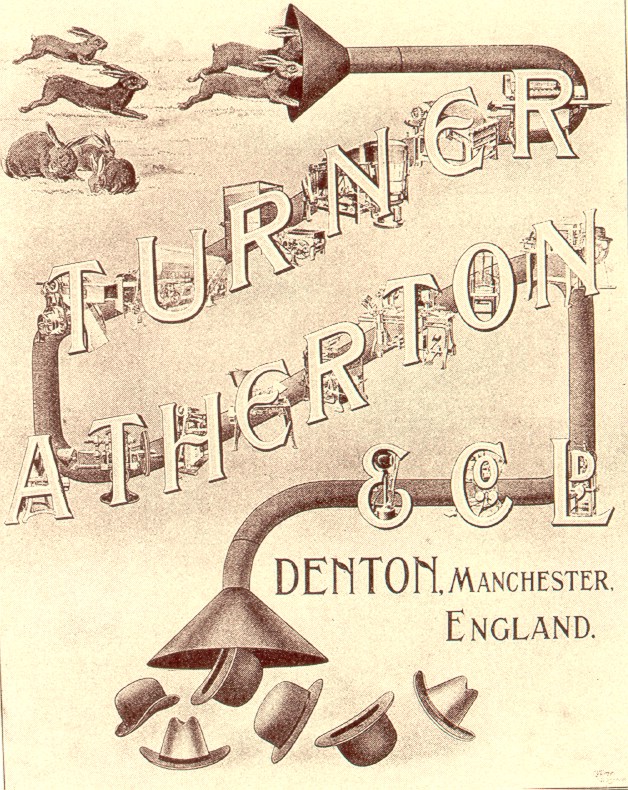
Every once in a while I realize I’ve been unconscionably neglecting that portion of the mission of this blog that relates to headgear; fortunately, what brings me to realize this is usually running across links that will remedy the situation, and such is the case today. From the cuniculous warrens of MetaChat, I bring you From bunny to brow: a step by step guide to how we make fur hats (from the fine folks at Akubra), as well as a collection of old hat ads; the latter includes a fine visualization of the “bunny to brow” concept.

ERRATA.

I was going through a pile of stuff from my distant past, and I came across an errata slip I seem to have acquired in the late ’70s. There’s no indication of the book it came from, and most of the half-dozen items are perfectly normal typos (p. 129, line 1, read “Gongbo” for “Gangbo”). But the first and last items are:

p. 57, line 14, read “pornographic” for “pomographic”;
Back cover, line 3, read “literature” for “illiterature”.

That’s what’s wrong these days: too much pomographic illiterature!