INDETERMINACY.

Eddie Kohler has, as one of his many online projects, Indeterminacy. From the About page:

John Cage was an American composer, Zen buddhist, and mushroom eater. He was also a writer: this site is about his paragraph-long stories—anecdotes, thoughts, and jokes. As a lecture, or as an accompaniment to a Merce Cunningham dance, he would read them aloud, speaking quickly or slowly as the stories required so that one story was read per minute.
This site archives 186 of those stories. Each story is spaced out, as if it were being read aloud, to fill a fixed area. If you like, you can also read them aloud at a rate of one a minute.

I got this from wood s lot, and I’m going to quote the same one quoted there, for what should be good and obvious reasons:

[Read more…]

MALAY PRONOUNS.

Over at aprendiz de todo, Prentiss Riddle discusses the complex set of pronouns given in Sir Richard Winstedt’s Colloquial Malay (Singapore, 1957):

…there are not only separate sets of pronouns for different combinations of social ranks, but a distinct set reserved just for addressing ethnic Chinese. Shades of John Wilkins! No wonder Winstedt goes on to say that “Malays shun the use of personal pronouns”—although the practice he describes of substituting nouns representing rank, title or metaphorical family relationship seems just as complex.
I’d write this off as a quaint and obsolete colonialism but linguablogger Jordan Macvay reports that the situation today isn’t much simpler. In fact he notes with surprise that many Malays have started borrowing the English I and you so as not to have to commit to one of the social relationships encoded in their own pronouns.

Jordan’s post is long and extremely interesting; an excerpt:

[Read more…]

POETRY BY HEART.

Geoff Nunberg is the LH house linguist not just because of his scholarship but because he’s able to put it at the service of a wider view of language and the world. His latest Fresh Air commentary is about learning poetry by heart, which he agrees with me in thinking a useful practise that should be revived (as Poetry is trying to do). He ends with the following passionate peroration:

If you think you can understand poems without feeling them in your body, you’re apt to treat them as no more than pretty op-ed pieces—you wind up teaching kids to value “The Road Not Taken” as merely a piece of sage advice about making difficult decisions.

I was about seven or eight years old when I learned Burns’s “Scots wha’ hae’ wi’ Wallace bled” from my dad. I had absolutely no idea what the poem was about or even what half the words meant. But I learned something else—how verse can become a physical presence, in Robert Pinsky’s words, which “operates at the borderland of body and mind.”

That’s an experience that you can only live fully when the poem comes from within rather than from the page in front of you. I like the way the Victorianist Catherine Robson put this: “When we don’t learn by heart, the heart does not feel the rhythms of poetry as echoes… of its own incessant beat.”

I was greatly amused, though, when he slipped one past whoever monitors Fresh Air for decency:

Unless you’re one of those freaks of nature who can soak this stuff up effortlessly, most of what you’ve got left of the poems you’ve learned is only snips and snatches—”My heart aches, and a something something pains my sense”; “I will arise and go now, and go to whatchamacallit”; “Ta tum ta tum, your mum and dad/They may not mean to but they do.”

That last quote is the opening of perhaps the best-known English poem of the last few decades, Philip Larkin’s “This Be The Verse“; I can’t imagine that anybody who’s once heard or read the line “They fuck you up, your mum and dad” could possibly half-remember it as “Ta tum ta tum, your mum and dad.”

Addendum 1. Dick & Garlick discusses the “Babu English” verb by-heart ‘learn by rote memorization.’

Addendum 2. Mark Liberman is “slightly surprised” at my reaction to Nunberg’s sly half-quote: “the FCC has no regulations against on-air quotations whose (unread) context includes forbidden words.” I’m sure that’s true, but I wasn’t talking about FCC regs so much as the general concern for suitability that prevails at NPR; I can’t imagine Frank Deford or Cokie Roberts alluding, even obliquely, to the word fuck.

KAFKA BLOG.

Following in the footsteps of Ray Davis’s posting of Barbellionblog (not to mention Phil Gyford and Pepys’ Diary), Paul Kerschen of Metameat has begun putting Kafka’s diaries online in blog form (German version here). On the About page he says:

Because many entries cannot be precisely dated, I have forgone the usual convention of placing a date above each entry. Kafka’s dates, when noted, appear in the body of the text. The German text is that provided by the Kafka Project. Entries appear in reverse order on the main page, in their original order on the archive pages. Ideally a new entry will appear every day, although longer entries may take more time.

On his own blog he says [scroll down to wed 15 jun 2005]:

So I have decided to do something very presumptuous, and have reached into the recent literary past in order to turn one of its pillars into my ideal blogger. He doesn’t link to things. He doesn’t tell you about his day—or if he does, it’s not an account of his day that would be recognizable to anyone else who was around. He’s not trying to impress anyone. He has no interest in convincing you through argument. Often his entries completely lose any diaristic quality and become a rehearsal space; we get to see him testing out scenes and sentences, sometimes for possible inclusion in longer work, sometimes for their own sake. Its final sentence, which will not appear online for a long time, is Auch du hast Waffen—you too have weapons. That is the overall dramatic arc: the author’s sustained attempt to master a frightening world by rendering it into language. It is white-hot.

Meet Franz Kafka’s blog. It will be there when you need it.

And the top post at the moment reads as follows:

Today, for instance, I was rude three times, once to a conductor, once to someone introduced to me—so there were only 2, but they pain me like a stomachache. Coming from anyone else it would have been rude; how much more so coming from me. So I went outside myself, struggled in the air, in the fog and the irritation that no one had noticed that even with my companions I had committed the rudeness as a rudeness, that I had to commit it, had to carry the true expression, the responsibility; but the worst was when one of my acquaintances took the rudeness not as a sign of character but as character itself, drew my attention to the rudeness and admired it. Why do I not stay within myself? Though now I say to myself: look, the world lets you strike it, the conductor and the man you were introduced to kept calm, the latter even said goodbye as you went off. But that means nothing. You can achieve nothing when you fail yourself, but what else do you miss in your own circle? To this speech I answer only: even I would rather suffer blows inside the circle than strike blows myself outside of it, but where the hell is this circle—for a while, yes, I saw it lying on the earth, as if squirted out with chalk, but now it just hangs like this around me, it doesn’t even hang at all.

(Via wood s lot.)

BOOKWORM.

Radio station KCRW has a regular feature called “Bookworm” in which authors are interviewed about their work; the half-hour shows are available online, and I can pretty much guarantee you’ll find something of interest. I was delighted to hear the talk (audio link) with Jonathan Williams (thanks, Andie!), and there’s also a link to excerpts from his new collection Jubilant Thicket: New & Selected Poems. And there are interviews with Ian McEwan, Roberto Calasso, Susan Sontag, August Kleinzahler, Orhan Pamuk, William Gass, Alex Garland, Octavia Butler, Robert Creeley, W. G. Sebald, Walter Mosley… Well, you get the idea. Lots of good stuff.

DES CHAPEAUX.

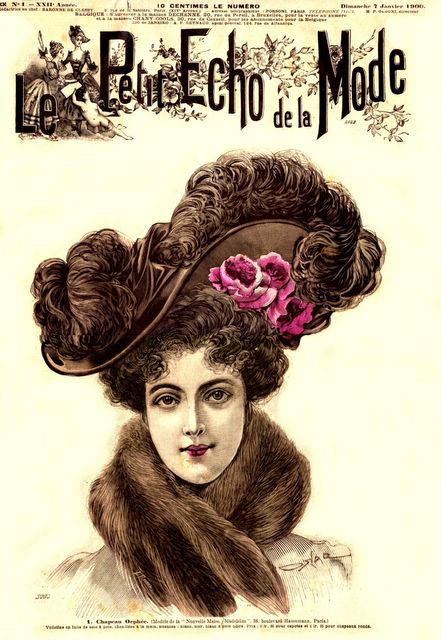
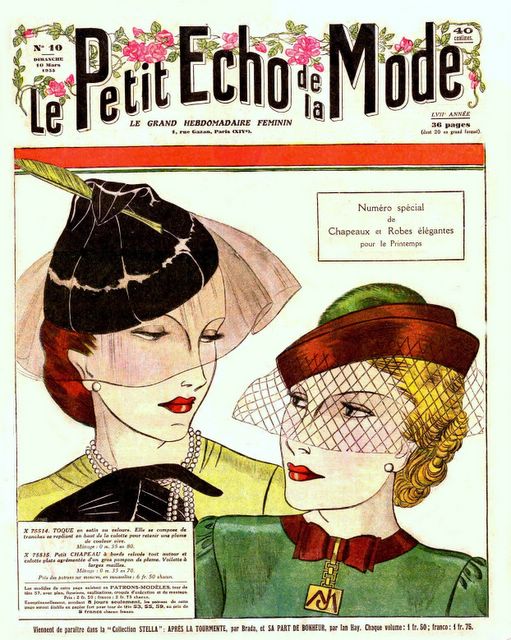
Pita’s hat blog. It’s nothing but hats… and it’s in French! Need I say more? Check out this 1935 cover—there’s a whole novella in that image. Or this wide-eyed and perhaps a bit complacent gaze from 1900: little does she know what the century to come will bring, the sad retreat from hat-wearing being the least of it. And men are not entirely neglected. (Mille remerciements to Derryl Murphy of Cold Ground!)

BIBLE TRANSLATION BLOG.

Wayne Leman’s Better Bibles Blog is dedicated to “improving English Bible translations” not so much in terms of accurately rendering the sense of the original (though of course that’s important to him) but in terms of rendering it into good, effective English, a goal he finds many current translations fall short of. When I ran across his blog, I was afraid Wayne was concerned about the sort of thing people often mean when they say “good English” (sentences ending with prepositions, split infinitives, that sort of nonsense), but I’m happy to report that’s not the case:

I am not a prescriptive linguist (that is, someone who tells people how they should speak and write). Rather, I am a descriptive linguist, someone who observes how people actually speak and write. I observe, as do many others, that the majority of English speakers continue to use subject-verb agreement, so in a published book, especially one as important as the Bible, I feel it is important to point out when there is lack of subject-verb agreement. Similarly, there are a number of other language “rules” (or “principles”) that fluent English speakers and writers follow that I believe should be followed in a book intended to be in quality literary English—at least they should be followed until there is a sufficient consensus (a large majority) among English speakers that those rules need to be changed…
I believe people have and should have linguistic choices. I do not think that “language police” should tell us how to speak, regardless of how well intentioned they are. I do think it is appropriate for English teachers to explain to their students what the current consensus is for usage of various linguistic forms. A teacher can explain that “If you want to be hired for some jobs, you need to be able to speak and write in a dialect that is approved of by the administrators of that company.” But no one should ever tell people that they are “dumb” or “social rejects” if they speak a certain way.

Amen to that! (I’m a King James man myself, but that’s because I read the Bible as a literary masterpiece, not as the urgent communication it must be to a believing Christian.)

BBC WORDHUNT.

Your language needs you!

Did you eat a balti before 1984 or have a mullet before 1994? And do you know how they got their names?
In conjunction with a major forthcoming BBC2 series, the OED invites you to hunt for words and help rewrite ‘the greatest book in the English language’.
250 years after Dr Johnson wrote his celebrated dictionary with the aid of just six helpers, the BBC and the Oxford English Dictionary have teamed up to appeal to the nation to help solve some of the most intriguing recent word mysteries in the language.
The OED seeks to find the earliest verifiable usage of every single word in the English language—currently 600,000 in the OED and counting—and of every separate meaning of every word. Quite a task! The fifty words on the OED’s BBC Wordhunt appeal list all have a date next to them—corresponding to the earliest evidence the dictionary currently has for that word or phrase. Can you trump that? If so the BBC wants to hear from you.

[Read more…]

PIE VERBS AND STRESS.

Piotr Gąsiorowski, who studied electronics and computer science at Warsaw Polytechnic from 1978 till 1984 and then, disappointed with “what computer science was like in Poland in those ancient times,” became a historical linguist instead, has put online some essays about Proto-Indo-European, notably one on stress and one on the verb system. While full of good meaty information, they’re written in such a way that readers without specialized training should be able to follow along, and with a sense of humor, always welcome in what can be a dry field: “I don’t know if any speaker of PIE ever said ‘O yoke’ to a yoke. I suppose the potential vocative would have received initial stress if it had occurred to anyone to use it.” (Via ilani ilani.)

Update (Sept. 2023). Piotr Gąsiorowski now at Google Scholar (he used to blog here, and occasionally makes an appearance at LH); Bridget D. Samuels of the ex-blog ilani ilani has a homepage.

THE BACKSTROKE OF THE WEST.

I haven’t seen Star Wars Episode III: Revenge of the Sith yet, and I’m not sure I need to now that I’ve seen these screenshots of a bootleg DVD with English subtitles retranslating the Chinese translation used in the version copied. As jeremy (who bought the DVD and posted the screenshots) says, “amazingly enough, the beginning scroll is mistranslated even though the words are right there on the screen.” And the title Revenge of the Sith becomes “The backstroke of the west” (I can only assume that Sith got rendered as xi ‘west’). I’ll let you discover the rest yourself, but I can’t resist noting that “Jedi Council” becomes “Presbyterian Church.” (Via MetaFilter.)

[Read more…]